






-
Publisher
Wiley
-
Date of Publishing
March 27, 2018
-
Book size
336 pages
-
Format
Hardcover & Kindle
Rating
About the book
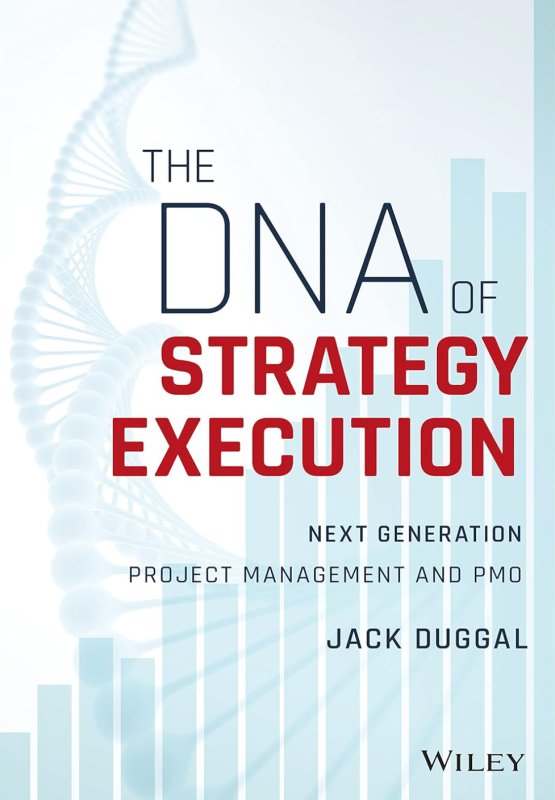
“The DNA of Strategy Execution: Next Generation Project Management and PMO” by Jack Duggal presents new insights on age-old management challenges and sheds light on better ways to organize and manage in an increasingly DANCE-world (Dynamic. Ambiguous. Non-Linear. Complex. Emergent). It puts the management DNA under the microscope, and demonstrates how to develop, establish, and transform organizational project management and PMO capabilities essential for effective strategy execution. The book provides a framework to measure what matters with a step-by-step approach to define and measure success and business value.
Whether you are a part of a startup, or an established incumbent organization, the impact of digitization and disruption requires a rethink and reset of how we organize and manage. This book offers a playbook for effective strategy execution with next-generation Project, Program and PMO capabilities.
AIPMO Review
Rating: 7.5 – This book presents a fresh perspective on Project Management Offices (PMOs) through a strategic lens, using what is termed the “DNA” of management—strategy, execution, governance, measure, connect, learn, and change. The author employs the DANCE acronym to expand upon the traditional VUCA model, embracing a dynamic, ambiguous, nonlinear, complex, and emergent business environment. These frameworks underpin a comprehensive view of the interplay between project management and PMOs. The book has a professional and clear design, making it easy to navigate. However, some readers may find it lacking in color and overly reliant on tables, which could reduce its appeal to a modern audience seeking visually engaging content. It boasts of readability due to clear and concise language, well-structured chapters, and strategic use of graphs and tables, which, along with leading questions at the start of each chapter, aid in demystifying complex theories and encouraging interactive learning.
The content is relevant across industries, enhancing its applicability. Each chapter operationalizes the concept of PMO’s “DNA,” providing detailed explanations and actionable steps for improvement. Real-life examples, such as the Boeing 787 Dreamliner and Thermo King, are used to ground theoretical concepts, although there is a noted lack of detailed case studies that fully utilize the DNA model for PMO, which leaves a gap in demonstrating comprehensive PMO concepts. The book’s approach is not prescriptive; rather, it aims to inspire adaptation and innovation in PMO practices, tailoring to the specific needs of an organization rather than offering a one-size-fits-all solution. While it provides a challenge and vision for experienced PMO and Project Management leaders, it may not be exhaustive for those looking to create or overhaul a PMO, indicating a potential need for more detailed information on PMO services.
Authored by Jack Duggal, an internationally recognized strategy execution and PMO expert, the book is suited for senior managers and seasoned professionals, providing a strategic and forward-thinking look at PMOs. Each chapter is supplemented with an extensive bibliography, emphasizing the author’s extensive research and grounding in the field. In summary, the book is a significant contribution to PMO literature, offering novel insights and a holistic approach to strategy execution, resonating with the complexities of modern business environments. However, its practicality is somewhat limited by the absence of a clear implementation roadmap and detailed service descriptions. Despite these shortcomings, the book’s unique integration of broad management principles within the PMO context makes it a noteworthy read for those interested in the strategic aspects of PMO/project management.
AIPMO's 10-point scale
The book’s design quality exhibits a professional touch with a simple and clear layout, and it is clear and easy to navigate. However, its full potential is hindered by the lack of color, restricting the opportunity for more engaging and dynamic visual presentations. While the text is conveniently segmented into digestible sections accompanied by useful diagrams, the overall traditional and classic design, with a substantial emphasis on tables, seems incongruous with its forward-looking theme of “Next Generation Project Management and PMO.” This mismatch between form and content may detract from the reader’s engagement and could be more thoughtfully aligned to enhance the book’s appeal to a contemporary audience seeking cutting-edge insights into PMO.
The book’s relevance is commendably high as it engages with the complexities of the contemporary business landscape using the DANCE acronym—Dynamic and changing, Ambiguous and uncertain, Nonlinear, Complex, and Emergent and unpredictable. This approach offers a broader lens than the VUCA model, enabling a comprehensive understanding of today’s intricate world and its implications for PMO strategy. It successfully navigates the domain of business agility, advocating for flexibility and robustness in organizational strategies, and underscores the criticality of networks in PMO functions.
The author’s methodology is not confined to a single industry, ensuring its wide applicability. The book adeptly situates the PMO as central to strategic execution, using the modern metaphor of DNA profiling to articulate the intertwined aspects of strategic execution in a manner that resonates with current and dynamic business environments. This contemporary relevance, coupled with its universal approach, renders the book an invaluable resource for understanding and navigating the intricacies of PMO roles across various industry contexts.
In terms of readability, the author successfully employs clear and concise language, which facilitates the digestion of the book’s rich detail. The thoughtful structure with well-proportioned chapters, along with logically organized paragraphs and sub-paragraphs, contributes to the ease of understanding. The inclusion of graphs and tables is a strategic choice that aids in demystifying complex theories. Moreover, each chapter is opened with leading questions, a pedagogical strategy that effectively engages the reader and encourages deep reflection on the content, thereby enhancing the interactive learning experience.
The book’s practical applicability in real-world scenarios is notably structured around the “DNA” elements of PMO, with each chapter initiating with probing questions and concluding with concrete takeaways. It provides in-depth explanations of each DNA element and actionable steps for improvement, rooted in real-life examples such as diagnostic tools and methods to discern PMO types and pragmatic suggestions for metric definition and spreadsheet simplification. However, the book’s shortfall is noted in its lack of a clear, step-by-step roadmap for implementation, leaving readers questioning whether a comprehensive or an incremental approach is required for effective PMO integration. Despite this, the book’s real-life anchored examples and practical tips contribute valuable insights for PMO practitioners.
The book distinguishes itself by taking a holistic approach to strategy execution, framing it through the lens of what the author terms the DNA elements of management: strategy, execution, governance, measure, connect, learn, change. This framework offers a comprehensive view of the interplay and dependencies within project management and PMO. While the concept of DNA provides a fresh perspective, the underlying elements are not entirely novel, echoing established models like the McKinsey 7-S framework and TOMs.
Moreover, the author introduces the DANCE acronym to characterize the business environment, a concept that extends beyond the traditional VUCA model. Throughout the book, well-known models are articulated, but it is the consolidation of PMO functions into a catalog of activities, albeit without detailed service descriptions, that adds a layer of originality. The exploration of business agility, the significance of stakeholder networks, and the emphasis on simplicity and cultural factors contribute to a nuanced synthesis of modern management thought. The book’s practical focus on how these insights apply directly to PMO and strategy execution offers a unique vantage point not commonly found in the literature. This novel integration of broader management principles into the specific context of PMO execution is where the book’s originality truly shines.
While the book is infused with real-life scenarios that serve to illustrate various points—ranging from Boeing 787 Dreamliner to Thermo King, and extending to entities in the energy and healthcare sectors—it lacks detailed case studies that fully employ the author’s complete DNA model of PMO. This gap in detailed case studies, typically a cornerstone for validating PMO concepts, is noted. Nevertheless, the provided examples do sprinkle the text with practical insights.
On the other hand, the vision for a “Next Generation” PMO presented in the book is not meant to serve as a one-size-fits-all model but rather as a conceptual framework that encourages aspiration towards innovation and adaptation. It seems the intent is to inspire a more tailored application of PMO principles that adapt to the unique contours of each organization, rather than a prescriptive, universally applicable model.
Jack Duggal is an internationally recognized expert in strategy execution and PMOs. He is a known speaker at international conferences and a TEDx speaker. He is the founder and CEO of Projectized Group, specializing in next-generation strategy-execution assessments, consulting, and training. He works with leading organizations from NASA to Silicon Valley companies and governments around the world.
The author’s DNA model is used to convey an overarching idea of what is involved. It’s noted that the book is particularly suitable for senior managers looking to gain a high-level understanding of PMOs. However, the book may not be comprehensive enough for those aiming to establish or rejuvenate a PMO, as it could benefit from more emphasis on PMO services. Despite this, the book is credited for presenting a challenge and a vision that can benefit experienced PMO and Project Management leaders, implying that it adds value by prompting seasoned professionals to think about PMOs in a strategic and forward-thinking way, and fostering their personal growth for professional development in project management leadership.
The author offers for each chapter a detailed bibliography (10-30 books, in total around 200 books). Throughout the book, there are several references to books.
An overarching picture is lacking; however, figures and tables are functional and follow a consistent style. Together, they help to capture the main points of the author and aid in understanding the offered theory.