






Book details
-
Publisher
Wiley
-
Date of Publishing
April 23, 2024
-
Book size
384 pages
-
Format
Paperback & Kindle
Rating

About the book
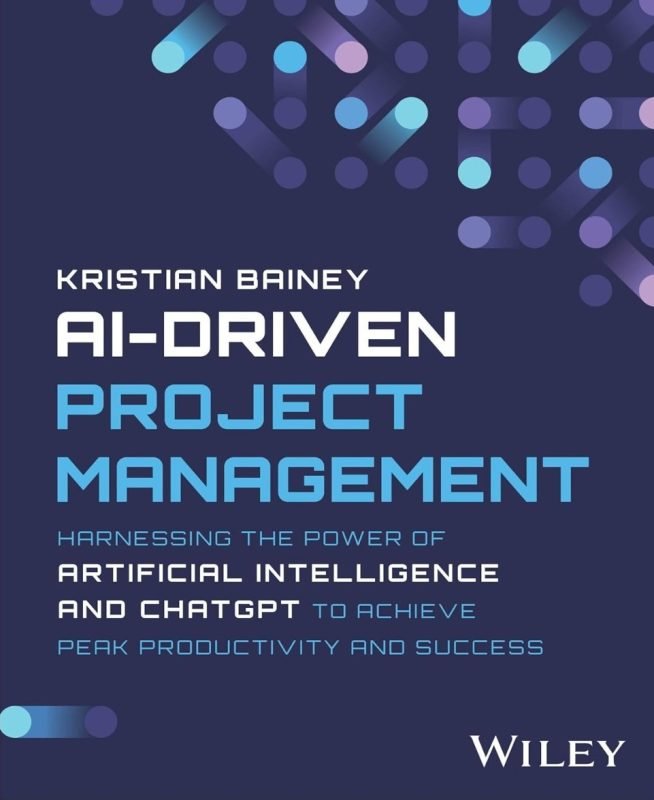
In AI-Driven Project Management: Harnessing the Power of Artificial Intelligence and ChatGPT to Achieve Peak Productivity and Success, veteran IT and project management advisor Kristian Bainey delivers an insightful collection of strategies for automating the administration and management of projects. The author focuses on four key areas where project leaders can achieve improved results with AI’s data-centric capabilities: minimizing surprises, minimizing bias, increasing standards, and accelerating decision-making. The book also includes primers on the role of AI and ChatGPT in Agile, Hybrid, and Predictive approaches to project management, guidance on how to accurately forecast a project with ChatGPT, and techniques for crafting impactful AI strategies using AI project management principles.
Perfect for managers, executives, and business leaders everywhere, AI-Driven Project Management is also a must-read for project management professionals, tech professionals and enthusiasts, and anyone else interested in the intersection of artificial intelligence, machine learning, and project management.
AIPMO Review
Rating: 8 – This book serves as a practical, well-organized, and reader-friendly guide for project management professionals seeking to integrate artificial intelligence, especially ChatGPT, into their daily workflows. With a modern, professional cover design and a clean internal layout, the book visually communicates its tech-forward focus and reinforces the credibility of its content.
The author employs simple, reader-friendly language, making complex concepts accessible to a broad audience. Whether readers are new to AI or have a background in project management, the book’s clear explanations and logical structure help bridge the gap between technology and practical application.
The book introduces ChatGPT using straightforward, entry-level examples, which are especially helpful for beginners. It explores common use cases in project management, allowing readers to understand how AI can assist with tasks such as communication, status updates, documentation, and decision-making. While the book does not delve deeply into advanced applications, it succeeds in delivering a solid foundation for future learning and use.
A key strength of the book lies in its variety of case studies. These real-world examples bring theoretical ideas to life, showing how ChatGPT can streamline workflows, support strategic thinking, and increase team productivity. They also make the book feel highly applicable and relevant to modern project environments.
Kristian Bainey, the author, brings over 15 years of experience in IT, project delivery, and digital transformation. His leadership roles, including his presidency of the PMI Northern Alberta Chapter (2023–2024), alongside his consulting and academic engagements, add depth and authority to the content.
The book also emphasizes the growing importance of foundational prompt engineering skills, especially as tools like GPT-5 emerge. It reinforces the idea that while AI capabilities will evolve, human input—such as critical thinking, clear instruction, and planning—remains essential.
Supporting content, such as diagrams, tables, and visuals, is thoughtfully placed to help clarify workflows and key takeaways. This visual support makes learning more intuitive and helps reinforce key messages.
Additionally, the book draws from a well-curated set of academic and industry sources, offering readers both context and credibility. While a more detailed discussion of API options and implementation techniques would add technical depth, the book remains a timely, relevant, and empowering resource. It prepares professionals to lead and adapt in a project management landscape increasingly shaped by AI.
AIPMO scale
The book cover has a modern, clean, and professional appearance. It captures the attention of readers interested in artificial intelligence, technology, and project management. The colors, shapes, and overall design effectively convey a message of innovation, suggesting that the book tackles current and tech-driven topics. Its layout is clear and easy to understand, giving it a credible and polished feel without appearing overly complex. The visual style aligns well with the book’s theme—exploring how artificial intelligence can enhance project management.
While some examples or tools mentioned in the book may become outdated as AI technology evolves, the book remains highly relevant—especially for learners new to ChatGPT.
This book provides a foundation in prompt engineering that may continue to apply across future iterations of AI models, in addition to offering core prompting skills.
The transition from GPT-4.5 to future capabilities—or even another AI tool—reinforces the need for strong foundational knowledge.
Future versions, such as GPT-5, are expected to enhance those abilities further, but they will not eliminate the need for users to think clearly and plan their interactions. Therefore, these skills will carry over, and those who learn now will be better prepared to thrive as the technology advances.
This is an easy-to-read book written in simple and clear language that helps connect with the reader. The content is well-organized and follows a logical structure, which makes it easy to follow. This clear way of communicating helps readers from different backgrounds in AI and project management understand the content without difficulty. The simplicity of the language makes the book more engaging and accessible to a broader audience.
The book explores several engaging topics, successfully blending practical recommendations with thoughtful conceptual discussions on integrating ChatGPT into project management. Many chapters provide clear, actionable insights that professionals can immediately apply, greatly enhancing the book’s value as a hands-on guide. While a few sections could benefit from more detailed usage examples or implementation tips, the overall content is highly accessible and relevant. Adding a consolidated overview of ChatGPT API options would further strengthen the book, especially for those interested in technical integration. Still, it serves as an excellent and timely resource for project managers looking to adopt AI in a structured and meaningful way.
The book introduces ChatGPT using simple, entry-level examples, making it a helpful starting point for beginners in project management. It highlights common industry use cases, which can aid newcomers in understanding initial applications. However, the absence of in-depth analysis, advanced scenarios, and critical exploration of transformative uses limits the book’s innovative contribution. While accessible and informative for novices, it does not significantly push the boundaries of existing knowledge or offer groundbreaking insights for experienced professionals.
The book includes a wide range of case studies that effectively illustrate how ChatGPT can be applied in project management scenarios. These examples are especially helpful for beginners, providing clear, relatable use cases that bring theoretical concepts to life. By grounding AI applications in practical situations, the book makes it easier for readers to see the potential of ChatGPT in streamlining workflows, supporting decision-making, and enhancing team productivity. The variety of case studies adds depth and reinforces the book’s role as a practical guide for integrating AI into everyday project work.
Kristian Bainey is a recognized expert in artificial intelligence and project management, bringing over 15 years of experience in IT, project delivery, and digital transformation across both public and private sectors. His strong academic foundation, industry certifications, and leadership roles—including serving as President of the PMI Northern Alberta Chapter (2023–2024)—reflect his deep expertise and active involvement in the field. Bainey also contributes as a consultant, university lecturer, and international conference speaker, with a focus on the intersection of AI and project management.
The book provides a solid foundation and practical guidance on how artificial intelligence, particularly tools like ChatGPT, can enhance project management. Its hands-on approach and actionable insights equip readers with the essential skills to integrate AI into their business practices effectively. By demonstrating how AI supports automation, strengthens data-driven decision-making, and enhances productivity, the book empowers professionals to become more resourceful, efficient, and competitive. It’s a valuable resource for those looking to strengthen their project management capabilities and prepare for emerging roles that demand technological fluency.
The book draws on a thoughtful mix of recent and classical references, providing a strong foundation for its discussions. This well-curated selection supports a rich understanding of both traditional and modern perspectives in project management and AI. The inclusion of diverse sources adds depth and context, making the content accessible and relevant to a wide range of readers. By blending academic grounding with practical insight, the book offers a well-rounded resource that encourages continued learning and exploration.
The book makes effective use of visual elements—such as diagrams, tables, and examples—where needed, helping to simplify complex concepts and clarify key ideas. These visuals support reader understanding by illustrating workflows and highlighting essential information in a clear and accessible way. Their thoughtful integration enhances the learning experience, particularly for those applying AI concepts to real-world project management scenarios. By combining well-placed graphics with clear explanations, the book succeeds in delivering both practical guidance and visual clarity, making it a strong learning resource for readers at all levels.