






Book details
-
Publisher
Sams Publishing
-
Date of Publishing
December 22, 2023
-
Book size
400 pages
-
Format
Paperback & Kindle
Rating
About the book
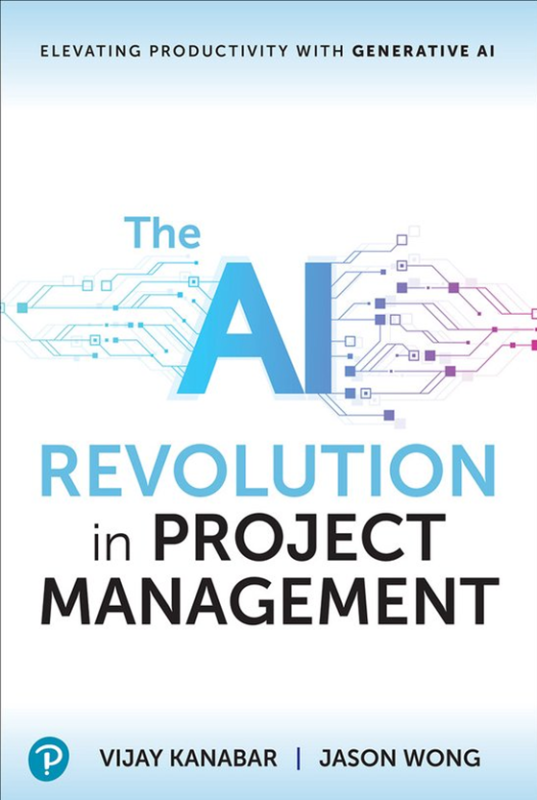
In a rapidly advancing world, the integration of project management and artificial intelligence stands at the forefront of innovation. The AI Revolution in Project Management explores the transformative potential of generative AI tools that promise to reshape industries and revolutionize project management.
Whether you’re aiming to build dynamic teams using AI, select a project development approach, or track project performance, this book has you covered. Each chapter provides valuable insights and includes a supplemental Technical Guide offering tips on utilizing AI technology. Through case studies and prompts, the dialogues demonstrate AI in action, from stakeholder engagement to risk management. Dive in with experts who have spent countless hours applying these AI tools in project scenarios to provide a transparent view into generative AI-driven project management.
In this book, you’ll learn how to create prompts that generate meaningful and actionable insights tailored to your projects, when to use AI to enhance decision-making, boost productivity, and elevate overall project efficiency, and which generative AI models and plug-ins to use for specific project scenarios, ensuring seamless integration and maximum effectiveness.
AIPMO Review
Rating: 6.2 – The AI Revolution in Project Management by Dr. Vijay Kanabar and Jason Wong is a practical, timely, and up-to-date assessment of how generative AI tools can support effective project management. It provides a clear and accessible guide to making the most of these tools, using helpful real-life examples. The book encourages readers to think beyond apparent applications and explore various ways AI tools can be used effectively.
AIPMO 10-point scale
The book employs various font sizes and bold characters, sometimes making it a bit difficult to read. All the screenshots are in black and white; adding color would make them more appealing. Its cover design is simple but striking and straightforward, and the image is relevant. Overall, the design supports the content and enhances the reader’s experience.
Currently, the book is very relevant in showing many examples of prompts to be used in ChatGPT and other similar generative AI tools to support the project manager. It clarifies that AI is relevant in generating text and can be very helpful in different areas like stakeholder management, planning, and risk management. On the other hand, the developments in GPT are so fast that the ideas offered could become outdated in the near future. The book focuses on existing technology and does not explore the range of ways in which AI is likely to develop project management further.
The book focuses on various topics a project manager faces but doesn’t explain the relationship between them. Therefore, it can sometimes feel disjointed and fail to hold the reader’s attention. If the book had used a continuous thread, such as following one project from start to finish, it would have helped the reader stay focused.
The book offers a high-level introduction to the technology concepts and detailed practical guidance on optimizing the use of AI by demonstrating examples of effective, prompt engineering. It provides several prompts for many topics and issues that you can immediately use yourself. It also includes the answers generated by ChatGPT and other generative AI tools. Many prompts are designed to help you make the right decisions and solve problems effectively.
The book introduces several prompts not related to text generation but aimed at supporting tasks such as stakeholder management, team building, and team management—topics you might not typically associate with ChatGPT and other generative AI tools. It provides new perspectives on using ChatGPT and similar AI tools and offers innovative ways to incorporate it into your work as a project manager.
The book is built around case studies and examples demonstrating how to use ChatGPT and similar AI tools for various topics. These examples support the underlying text and help to clarify and enhance understanding.
Dr. Vijay Kanabar is an associate professor at Boston University’s Metropolitan College and was honored with the PMI Linn Stuckenbruck Teaching Excellence Award in 2017. He has advised many companies but is not very active on social media platforms. Jason Wong is an IT leader at a Boston-based hospital and an adjunct professor at Boston University.
The educational value of learning how to effectively use ChatGPT and other generative AI tools as a project manager is significant. The examples provided can be seamlessly integrated into your workflow, helping you view various topics from a different (ChatGPT and other Generative AI tools) perspective. While it offers substantial support, the impact on your personal growth is limited.
There are almost no references to other books or websites. If there are references, they are in the footnotes.
The screenshots are difficult to read, and the table format is used inconsistently, sometimes including table names and mostly not. Charts, especially those with multiple lines, are hard to distinguish. Additionally, the figures lack a consistent look and feel, often varying between 2D and 3D views.