






Book details
-
Publisher
Independently published
-
Date of Publishing
April 2, 2025
-
Book size
91 pages
-
Format
Paperback, Hardcover, & Kindle
Rating

About the book
In today’s fast-moving world of product leadership, maintaining balance is the difference between thriving and burning out. Balance takes you on a transformative journey, blending the wisdom of martial arts with the realities of leading product teams.
Through the story of Steve, a product leader struggling with chaos, self-doubt, and the pressures of modern leadership, this book reveals how true mastery comes from balance—between vision and execution, structure and flexibility, control and trust. Guided by insights from the dojo and real-world product challenges, Steve discovers what it truly means to lead with clarity, resilience, and discipline.
This is not just another book on product management—it’s a leadership parable that will change how you think about building teams, making decisions, and creating products that truly matter. Discover how to create products people will never want to give up. Perfect for product managers, entrepreneurs, and leaders looking to find their center, inspire their teams, and build products that make an impact. If you’re ready to escape the chaos and lead with confidence, this book is for you.
AIPMO Review
Rating: 7 – Balance by Chris Lukassen presents a refreshing take on leadership, blending personal experience, storytelling, and lessons from Judo to emphasize balance in both professional and personal life. The book is structured into four sections that move logically from building strong teams, to mastering leadership techniques, to shaping culture by being present at the Gemba, and finally to engaging top management in fostering a We Culture.
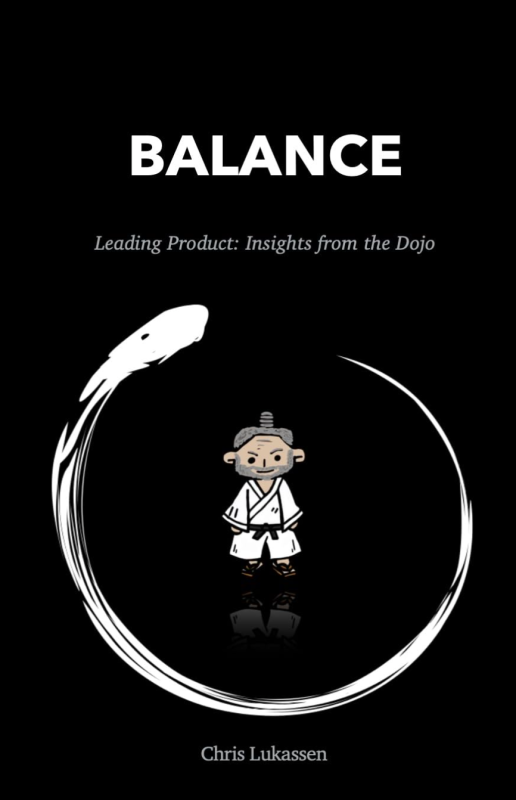
The design is simple yet effective. Its striking black-and-white cover with a handcrafted samurai illustration links directly to the book’s themes, while the typography is clear and consistent, making it easy to read. Inside, the writing is light, engaging, and accessible, with stories and takeaways that avoid the jargon typical of leadership books.
Each chapter ends with a “practical kata,” a set of exercises encouraging readers to internalize lessons and apply them in daily life. The fictional character Steve serves as a continuous case study, illustrating how leadership is not confined to the workplace but permeates family, community, and personal growth. While effective, this reliance on a single fictional case makes the examples somewhat narrow, lacking the diversity of perspectives found in real-world case studies.
Linking leadership to Judo, kata, and repetition is creative and adds freshness, but the underlying concepts largely rest on established leadership ideas. The research is well-supported by personal and professional references, yet the depth is limited; many footnotes are translations rather than substantive academic sources.
Visuals are clear and thoughtfully designed, with black-and-white drawings and annotations that enhance storytelling. However, they are used sparingly, and more diagrams or structured visuals could have improved comprehension further.
The author’s strong background in product management, coaching, and martial arts provides credibility, and his mission to inspire balance and purpose is evident throughout. Overall, Balance is engaging, practical, and thought-provoking, offering meaningful guidance on leadership as a way of life. It leaves readers motivated to reflect, grow, and approach leadership with renewed clarity and purpose.
AIPMO scale
The book cover design is visually striking, with the black and white colors effectively emphasizing the title and illustration. This minimalistic approach captures the essence of the book with clarity and purpose, while the handcrafted samurai drawn on the cover provides an explicit analogy with the book’s content. The typography is particularly well executed—the choice of font, along with the thoughtful sizing and spacing, contributes to an enjoyable reading experience.
The book explores the soft skills essential for leadership, offering a fresh perspective through the lens of the author’s personal journey and the lessons he learned from practicing Judo. The author uses a fictional character named Steve to highlight the importance of seeking balance in every aspect of business and personal life, instead of engaging in the race for “more.” The author clearly outlines, in four sections, a clear approach to leading effectively.
Chapter 1 lays down the foundations for building a strong team.
Chapter 2 details the techniques required to lead effectively, introducing concepts from martial arts (such as Kata and Randori) to illustrate how effective leadership is implemented.
Chapter 3 explains how a leader should interact with the team and emphasizes the importance of being present at the Gemba (the actual place where the team is) to shape the culture from within.
Chapter 4 offers key considerations for leaders to engage top management in fostering a We Culture.
The book is well written, with ideas presented coherently and supported by relevant personal and professional experiences. The clear and accessible language keeps the reader engaged throughout. Unlike the usual technically and theoretically jargon-filled books, Balance is written in a light, storytelling style filled with easily digestible takeaways drawn from the professional and personal lives of the main character.
At the end of each chapter, the author provides practical kata—actionable items that help the reader identify and internalize the concepts discussed. These exercises effectively bridge theory and practice, enabling readers to apply the insights in both their professional and personal lives. The book narrates Steve’s experiences in his professional life as a product director and in his personal life as a husband, father, and martial artist. His journey takes us into his home, his children’s judo school, and his workplace, highlighting the key lessons he draws from those places to implement at work. The author demonstrates that being a leader is not a job but a way of life that permeates every aspect of a person’s life.
Though the book offers a fresh perspective on leadership—emphasizing it as a way of life—it primarily presents a new angle on existing ideas, contributing to a refreshing and thought-provoking take on well-established concepts. It is also important to underline the innovative approach taken by the author in linking leadership to the practice of Judo. Drawing from the concept of kata and repetition in martial arts, the author includes guided exercises to highlight essential values of leadership (balance, accountability, purpose, discipline, etc.) alongside lessons learned from martial arts. The kata at the end of each chapter, consisting of repeated exercises, helps readers master the concepts presented. By using this approach, the author reinforces each chapter’s topics and ensures that the concepts are understood and adapted to the reader’s own life.
Instead of highlighting the concepts through traditional case studies and real-life examples, the author takes readers through the life of a fictional character named Steve, whom he uses as a continuous case study to illustrate his ideas. Through Steve’s personal interactions (with his wife, children, and Judo Sensei) and professional interactions (with his manager, subordinates, etc.), the author thoughtfully translates the lessons to reinforce his postulate—that leadership is a way of being. These life anecdotes are conveyed succinctly and analyzed briefly to draw meaningful conclusions.
Chris Lukassen is a seasoned product manager, expert, coach, trainer, and martial artist. He is well recognized in the Netherlands and has also made notable international contributions. As the author of several books, he regularly delivers product development training sessions across the Netherlands and occasionally shares blogs on his social media. Chris is on a mission to shift how people approach product creation by enabling them to develop new products in the most effective way.
The author explores key leadership concepts such as adaptability, accountability, and purpose. Each chapter concludes with what the author calls a practical kata—a set of actionable items designed to help readers translate the concepts into practical steps in their personal and professional lives. The author emphasizes that leadership is a way of being, and as such, the book is structured around the following pillars that ensure personal growth: teaching through lessons learned and storytelling, kata (ensuring that the reader pauses, reflects, and enhances their practices), and continuous improvement.
In terms of research quality, the book demonstrates a balanced but moderate level of rigor. The author draws on a diverse range of references from personal, academic, and professional domains, effectively supporting the content throughout. He displays commendable effort in documenting references and sources, with each chapter beginning with a relevant citation and additional references thoughtfully integrated to enrich the narrative. However, the depth of research is somewhat limited: of the 42 footnotes included, only a few refer to substantive books or academic works, while many are simple translations of Japanese terms.
The illustrations are clear and effectively support the reader’s understanding of the concepts. The design and formatting of the visuals are consistent with the text, reinforcing the clarity and coherence of the ideas presented. The data visualizations are very clear and simple, effectively supporting the storytelling of Steve’s journey. These visuals do an excellent job of communicating the ideas conveyed in the book. The use of simple black-and-white drawings and a clear title immediately draws attention to the key insights. The annotations provide essential context and complete the story, turning the simple drawings into a compelling and actionable narrative. The author has used visuals sporadically yet efficiently to convey the messages in the most effective manner.