






Book details
-
Publisher
Quality Project Initiative
-
Date of Publishing
May 31, 2021
-
Book size
152 pages
-
Format
Paperback, Kindle, & Audiobook
Rating

About the book
Is your PMO doomed to fail? Have you ever paused to consider how deep the PMO graveyard in your organization goes? Three layers deep? Five? More? The million-dollar question is: Are you doing anything differently? But all is not lost. What if you could reverse the trend? Could you be the one who pulls the sword from the stone and ends the curse?
Let this guide be the Merlin to your King Arthur. It holds everything you need to break the cycle for good (while proving once again that you can achieve the impossible).
This isn’t a half-hearted “ultimate guide to X” written by a copywriter to chase clicks. Nor is it a Buzzfeed-style list of “five things you need to know when running a PMO.” Creating High Value PMOs is a comprehensive work, authored by an expert who has lived and breathed every recommendation. It shares the true foundations for PMO success.
With extensive content and a host of brand-new techniques, this guide is for those committed to making real improvements in their work. You will learn how to break free from the administrative death cycle, the difference between valuable and doomed PMOs, the three simple steps to clarify your value and communicate it, how to rally your team to build momentum and community, and how to overcome the cultural pitfalls that undermine PMOs.
AIPMO Review
Rating: 6.75 – The book Creating High Value PMOs: Your Essential Guide by Brendon Baker is enjoyable to read, with well-structured chapters. It focuses on “value” and the organizational setup of a new PMO. The methodology for addressing the topic of “value” is both useful and more comprehensive than what is presented in many other books. However, the lack of examples and in-depth details makes it challenging to measure “value” in real-life applications.
The explanation of how to integrate a new PMO into an existing organization, along with key considerations, is well-executed. Potential pitfalls are thoroughly documented. Nevertheless, the absence of practical examples, particularly concerning measurability, leaves some questions unanswered.
The inclusion of a procedural description of what the first 100 days of a PMO setup might entail is an innovative addition to the market and deserves positive emphasis.
There are no references to research in the discussed areas, which suggests that the ideas and solutions are based solely on the author’s experience. While this is not necessarily a drawback, it prompts an exploration of the general applicability of the book’s content.
The book provides actionable suggestions and inspires readers to experiment with its ideas. However, it is worth noting that the graphics in the Kindle version differ from those in the paperback. While the paperback graphics are crisp and clear, the Kindle version appears less sharp.
AIPMO 10-point scale
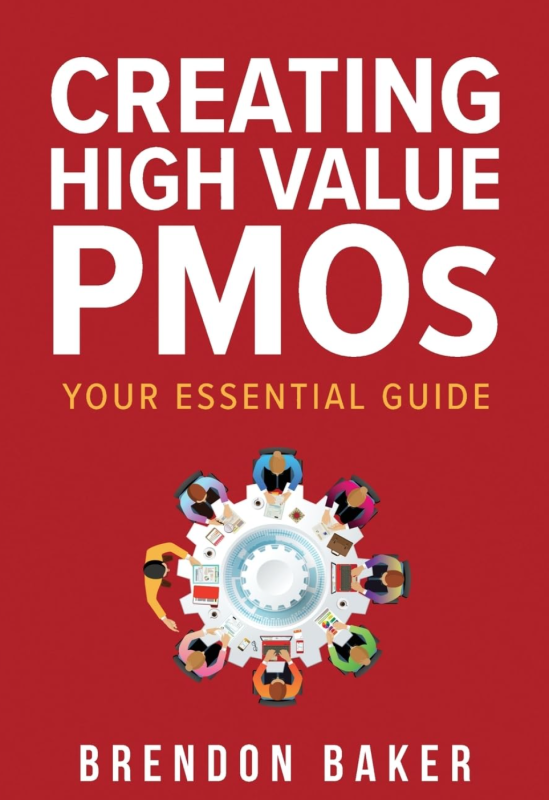
The book’s essence is captured through the picture of a team working. The wheel in the center represents teamwork, which is essential for a PMO to add high value. The book is logically organized into three major areas; however, the index does not reflect this structure, making navigation somewhat challenging. Readers may need to go through the text step by step to grasp its organization fully.
The book is relevant to current trends in the PMO world. The industry realized that for PMOs to add value, they have to shift from being administration hubs to focusing on providing added-value services. The author’s argument throughout the book urges PMOs to move from the administrative cycle of death (or PMO curse) and move into the high-value circle/value continuum.
The chapters are well-structured, clear, and easy to read. The content follows a logical flow, and the conclusions are straightforward. The writing style is direct and engaging, making the reading experience enjoyable.
At the start of each chapter, the author includes quotes that capture the essence of the section. The motto “keep it simple” is reflected in the writing style and the book’s structure. However, at times, the simplicity of the structure may cause the reader to lose track. Overall, the author succeeds in making the reading enjoyable and engaging.
The book outlines a path forward with explanations and advice on setting up a PMO organization, focusing primarily on the organization itself and its environment, team, and management requirements. The explanations are clear and practically applicable, though they remain superficial, lacking depth and concrete examples. The author offers practical tips throughout the book and, in the final chapters, provides a game plan for implementing PMOs.
The book describes how to ensure value in a PMO organization in three steps. Step one is “get clear,” step two is “rally people,” and step three is “avoid cultural traps.” It highlights various logical and comprehensible issues, but actually, on closer inspection, it is not new. But well summarized. After the three steps to a high-value PMO comes a short description of the first 100 days of a PMO set-up. It’s about clarity of purpose, rituals, rallies, community, reflection, and refinement. All this remains on the surface, and the real implementation details remain hidden. The value part is seldom found in other books, and the approach sounds reasonable but lacks the grade of details.
The author appears to use personal experience as case studies to illustrate certain concepts in the book. However, these examples are presented superficially, without proper referencing or sources (e.g., the Clean Drinking Water case to demonstrate the power of purpose on p. 20, or the ICT PMO example on p. 89).
Brendon Baker is a proven change management expert. In addition to this book, he has also written a book called “Valuable Change,” which deals with the topic of leadership change, which certainly fits in well with the PMO topic. It is his first book on PMO, which is also available as a hardcover and audible version. Additionally, the author engages the community through a newsletter that people can subscribe to.
The book focuses on the concept of value in general and specifically for PMOs. Its strength lies in providing a coherent approach to building a PMO organizational structure within a company, emphasizing interaction with existing structures and gaining acceptance within the organization. Team building and addressing mistakes within such a setup are also highlighted.
However, the book lacks a detailed explanation of establishing individual PMO services. The approach is only discussed strategically, focusing primarily on organizational acceptance, which is important, but leaving out the framework for day-to-day operations. Key project management concepts such as Project Portfolio, PMO reporting, governance, templates, and stakeholder management are not addressed. The book doesn’t clarify what a PMO should do after its organizational setup.
Additionally, the author provides only a list of potential services. Given that the book aims to serve as a guideline for implementation, it would be beneficial to include high-level information on each service (e.g., definitions, involved stakeholders, critical success factors). This could improve future editions of the guide.
The author provides statistics without any references (for example, the percentage of PMO filing lessons learned documented without any reference). Regarding the citation, the author offers a quote at the beginning of every chapter, summarizing the essence of the chapter. The key takeaways’ fonts are bolded to catch the readers’ eyes.
The author effectively uses visuals to capture the essence of the chapters and the book as a whole. These visuals efficiently convey key concepts, such as the “Administrative Death Cycle” on p. 8 and the “3 Steps to High-Value PMO,” enhancing the reader’s understanding. The graphics in the Kindle version appear different from those in the paperback. While the paperback graphics are clear, the Kindle version is not as sharp.