






Book details
-
Publisher
Routledge
-
Date of Publishing
May 23, 2024
-
Book size
344 pages
-
Format
Paperback, Hardcover, & Kindle
Rating

About the book
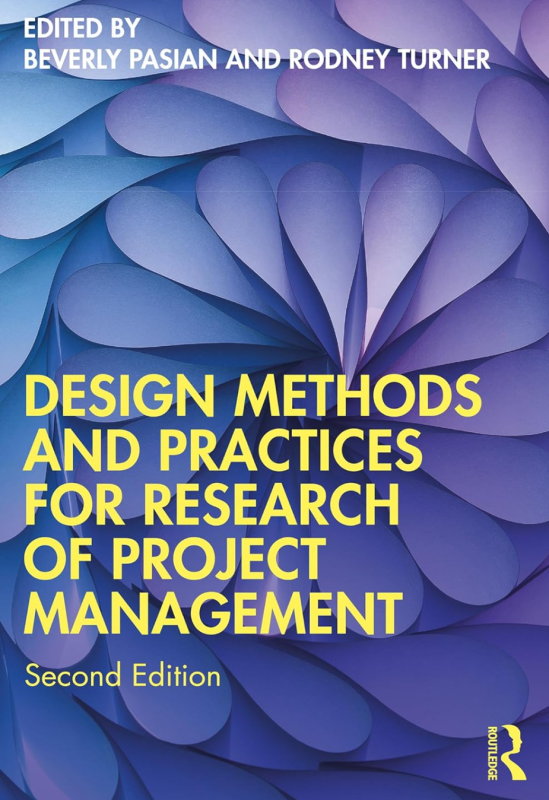
Design Methods and Practices for Research of Project Management is the most comprehensive guide on how to conduct research in and on project management. Project management as a discipline has experienced near-exponential growth in its application across the business and not-for-profit sectors. This second edition of the authoritative reference book offers a substantial update on the first edition, with over 60% new content, and provides both practitioners and student researchers with a fully up-to-date and comprehensive guide to research practice in project management.
In this book, Beverly Pasian and Rodney Turner have brought together 26 original chapters from many of the leading international thinkers in project management research. The collection examines each step in the research stages, including research strategy, management, methodology (both quantitative and qualitative), and techniques, as well as how to share and publish research findings. The chapters offer an international perspective with examples from a wide range of project management applications: engineering, construction, megaprojects, high-risk environments, and social transformation. Each chapter includes tips and exercises for the research student, along with a comprehensive set of additional references.
The book is the go-to text for practitioners undertaking research in companies, as well as doctoral and master’s students and their supervisors involved in research projects within universities.
AIPMO Review
Rating: 7.6 – This edited book serves as a valuable resource for graduate students, researchers, and practitioners interested in project management, providing the most in-depth framework for exploring and conducting research in this field. It presents the topics in a clear, well-organized, and easy-to-understand way, addressing issues that are both current and important to the evolving demands of the field. Organized into thoughtfully designed chapters, the book effectively guides readers through complex concepts while maintaining clarity and coherence.
A central strength of the book is its ability to translate professional experience into academic insight. The structure and content are firmly grounded in real-world relevance, allowing readers to connect theoretical frameworks with practical applications. This is particularly useful for those navigating the challenges of project environments marked by volatility, uncertainty, complexity, and ambiguity (VUCA). Though the design is functional and reader-friendly, incorporating more visual elements—like infographics or creative layouts—could enhance engagement, especially for visual learners.
The book excels in addressing contemporary research challenges and aligning with industry needs. It explores key themes such as action research, systems thinking, and reflective practice, providing frameworks that are both academically rigorous and practically applicable. These topics are explored in depth, providing readers with clear methodologies to address real-world problems while upholding scholarly standards.
The language throughout the book strikes a careful balance between academic tone and clarity. Despite occasional areas where phrasing could be more concise, the text remains highly readable and engaging. Complex technical ideas are presented in a way that is intellectually rigorous yet understandable to a broad audience.
It delivers practical guidance on mentoring, converting dissertations into publications, and applying experiment-based research in project contexts. These insights, reinforced by structured learning aids, enhance its usability for readers seeking to apply knowledge in academic or professional contexts.
The book takes a creative approach to research methods. Concepts such as metamodernity, complexity science, and integrative mixed-methods research challenge conventional thinking and promote a more adaptive and creative approach to project management studies.
Edited by Beverly Pasian and Rodney Turner, with contributions from 40 seasoned professionals, the book’s credibility is reinforced by the extensive academic and practical expertise of its authors. Overall, this book stands as a definitive and forward-thinking guide for anyone seeking to bridge academic research and practical application in the field of project management.
AIPMO scale
The book presents a clear, structured layout with well-organized chapters, tables, and study points that enhance comprehension. The design effectively illustrates how professional experience is connected to academic ideas, making the book easy to follow and understand. For instance, Chapter 14 presents the career of Simon Addyman, who spent 30 years managing infrastructure projects before transitioning into academia. This narrative is embedded within a framework that seamlessly bridges practical experience with theoretical insight. While the functional design serves the academic purpose well, the overall aesthetic could benefit from more visual enhancements—such as infographics or creative formatting—to make the book more visually engaging for readers.
The book’s emphasis on academic writing, mentoring, project management research, and complex systems theory makes it highly relevant to scholars, researchers, and practitioners in project management and related fields. Its chapters are well-aligned with contemporary academic challenges and the evolving needs of industry, particularly in navigating the complexities of research and management practices. For example, this relevance is clearly demonstrated in Chapter 9, which explores action research as a method for engaging stakeholders through iterative cycles of reflection and intervention. The chapter illustrates how this approach effectively bridges academic rigor with practical application, offering a valuable framework for generating actionable outcomes within organizational contexts.
The book employs academic yet accessible language, striking a thoughtful balance between theoretical discussions and practical advice. This approach ensures clarity and engagement for its target audience of graduate students, researchers, and academics. While certain sections could benefit from more concise phrasing, the overall readability is strong. For example, Chapter 17 discusses the application of Building Information Modeling (BIM) in hospital settings. The chapter presents complex technical concepts—such as planning and operational modeling—in clear, jargon-free language, effectively communicating advanced topics to both academic and practitioner audiences.
The book offers practical insights that readers can readily apply to both academic and professional contexts. Topics such as transforming dissertations into publications and effective mentoring are especially relevant to real-world scenarios in academia and project management. The inclusion of practical tips and study points further enhances its usability, for example, Chapter 10, which explores experiment-based research in project portfolio management. The chapter clearly outlines how specific interventions can be tested and measured in controlled environments, providing methodological steps that are directly transferable to real-world project settings—effectively bridging the gap between research and practice.
The book introduces innovative ideas that push the boundaries of traditional project management literature, particularly in addressing the challenges of complex project environments and the VUCA (Volatile, Uncertain, Complex, and Ambiguous) world. Concepts such as metamodernity, systemic research, and complexity science offer fresh, forward-looking perspectives that enrich the discourse. Innovation is also central to the book’s methodological approach. For instance, Chapter 6 advocates the use of mixed methods to navigate project complexity, challenging the conventional divide between qualitative and quantitative paradigms.
The book provides a solid methodological foundation for experienced researchers; however, for practitioners and beginners in project management research, it tends to be a dense read and conceptually distant from the innovative demands of the field.
The book effectively uses relevant examples and references to academic practices and project management challenges. While it provides a solid foundation, some sections could benefit from more detailed case studies to better illustrate complex theories and enhance their appeal to practice-oriented readers. A notable exception is Chapter 8, authored by Rodney Turner, which enriches the text with a strong focus on case study research. Drawing on a range of international empirical investigations, this chapter demonstrates how diverse real-world scenarios can be systematically analyzed. It adds valuable depth and practical relevance, offering readers clear guidance on applying case study methods in their professional contexts.
The editors, Beverly Pasian and Rodney Turner, bring substantial expertise and authority to the text, evident through critical insights, references to their research, and reflections on professional experience. Their strong academic backgrounds and established reputations in project management enhance the book’s credibility and depth. This is further reinforced by the inclusion of 40 high-profile contributors, each bringing unique perspectives and subject matter expertise to the chapters they authored. The presence and authority of the editors/authors are apparent from the introductory section, particularly in the biography of Rodney Turner, whose extensive contributions—including authoring or editing 18 books and serving as the long-time editor of The International Journal of Project Management—underscore the academic and professional influence behind the work. Together, these elements establish a solid foundation of trust and relevance for readers across academic and practitioner communities.
The book places a strong emphasis on mentoring, self-reflection, and continuous learning, encouraging readers to pursue both academic excellence and personal growth. Through practical guidance on publishing, writing, and navigating academic challenges, it supports the development of essential academic and professional competencies. Personal growth is further reinforced through reflective engagement with the research process. For instance, one author shares her academic journey toward socially responsible and creative project research, particularly in areas like gender leadership and quality of life in smart cities. This narrative, found in the biographical section, exemplifies how research design can catalyze both professional and personal transformation.
The book uses many references from both classic and contemporary academic sources. By referencing foundational theories in project management, sociology, and complexity science, it establishes a strong academic foundation and consistently upholds high research standards and academic rigor. This commitment to research quality is exemplified in Chapter 16, which focuses on methodological integrity. The chapter explores the challenges of conducting valid and reliable research in smart city contexts, emphasizing the importance of triangulation and multi-stage validation. It also highlights the value of field notes and reflective journals as legitimate data sources in ethnographic studies, reinforcing the book’s dedication to robust and credible research practices.
While the book includes some tables and figures to support its arguments, it could benefit from more visual aids, such as diagrams, charts, or infographics. The limited use of data visualization tools makes some sections feel dense and theoretical, which might hinder comprehension for more visually-oriented readers.