






Book details
-
Publisher
Agily Pty Ltd Publishing
-
Date of Publishing
August 14, 2023
-
Book size
382 pages
-
Format
Paperback & Kindle
Rating

About the book
Most Agile Transformations fail because there is a 10- to 20-year knowledge gap among the leaders who run companies that need transformation.
Most C-suite leaders have never worked in Agile teams themselves. As a result, they reach for the wrong tools and fall into the consulting trap by investing in large consultancies and trademarked™ “one size fits all” Framework approaches.
That is a recipe for expensive failure.
In Empowered Agile Transformation – Beyond the Framework, author Alexandra Stokes reveals how corporations, both large and small, have achieved successful transformations without relying on large consultancies or heavy Agile frameworks.
Better yet, you’ll discover the simple steps you can take today that’ll empower you to achieve a successful transformation as well.
Inside this book, you’ll discover answers to over 100 of the most frequently asked questions and objections corporate leaders face during transformation. It also includes 30 “real-world” case studies from companies that have successfully applied the principles of Empowered Agile Transformation to radically change their organizations. Plus, the author presents a simple, practical approach you can apply to your own teams, enabling them to achieve success without relying on heavy frameworks.
AIPMO Review
Rating: 6.4 – Empowered Agile Transformation: Beyond the Framework by Alexandra Stokes offers a fresh perspective on agile transformation, focusing not on rigid frameworks, but on the principles and mindset that drive meaningful change within organizations. The book emphasizes the importance of adopting an agile mindset rather than following predefined patterns or external methodologies like SAFe, Kanban, or Scrum. Through real-world examples, the author illustrates how companies can achieve success by focusing on delivering value and fostering an agile culture—though broader industry examples would have added more depth.
The book’s structure is clear and well-organized, offering practical insights tailored for executive leaders who play a key role in driving transformation. The author includes over 30 real-life case studies from organizations that have applied the principles of Empowered Agile Transformation to radically reshape their operations. These case studies serve as valuable references, blending the author’s personal experience with actionable strategies that can be adapted to any organization.
A key feature of the book is its focus on the importance of mindset and principles over frameworks. The author challenges the conventional view of agile as just a set of practices, questioning whether it’s a mindset, an ideology, or even a cult. The book emphasizes the need for leaders to focus on long-term value, not just “being agile,” and cautions against using agile as an excuse for skipping documentation or quality.
Despite its strengths, the book mainly focuses on software development, which may limit its relevance for organizations outside this sector. Additionally, while the author promotes transformation as the key to success, there is little discussion on when this approach might not be suitable.
Overall, Empowered Agile Transformation is an insightful and practical guide for executives looking to lead their companies through an agile transformation, offering strategies and principles that transcend traditional frameworks.
AIPMO scale
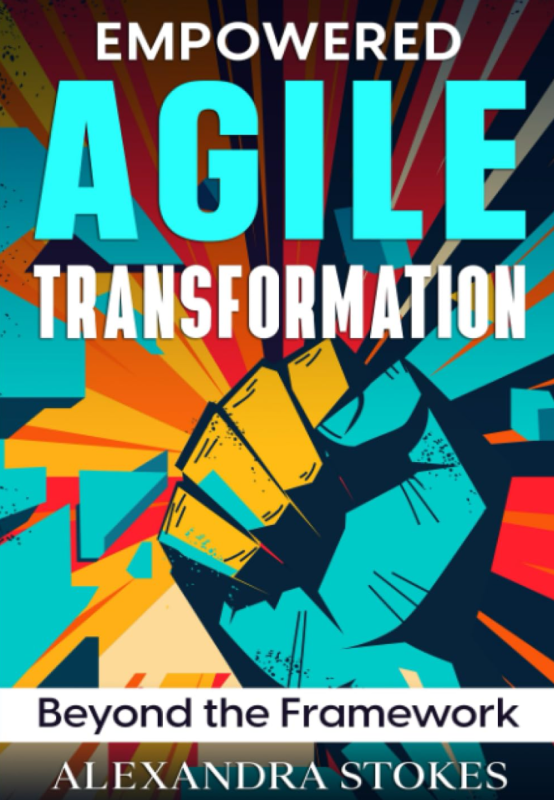
The book has a soft cover and is well-structured. It doesn’t use any color, but the grey tones make it easy to read. The cover image—a fist breaking through glass—is visually striking and clearly symbolizes the idea of going beyond frameworks. The content is thoughtfully organized and easy to follow. A Kindle version is also available for digital readers.
The book is timely, as many organizations are still transitioning to agile methodologies. However, it mainly focuses on software development, which limits its relevance for other industries.
A strong point is the author’s focus on delivering value, not just “being agile.” It’s also good that the book questions whether agile is a mindset, an ideology, or even a cult, highlighting how some use it as an excuse to skip documentation or quality. Importantly, it reminds us that an agile mindset is far more valuable than a purchased framework. With agile ways of working, it is more effective to focus on the mindset and principles we can all agree on, rather than looking for inspiration in pre-made, trademarked frameworks.
The book is well structured and easy to read. Its language is tailored for experts, especially executive management, translating agile and lean concepts into management thinking. The idea of steering a company by following the journey rather than a fixed plan is debated, but it is essential if agility is the goal.
The author strongly believes that transformation is the only way to manage a company involved in software development. However, it would have been helpful to include some discussion on when this approach might not be suitable, but such a balance is missing.
In simple terms, the book translates the full Agile Manifesto—with all its implications for requirements, change, budgeting, funding, organization, and processes—into a language that speaks to top management.
The content offers detailed insights into how to truly engage a company in transforming its organization, without relying on predefined patterns or limiting frameworks. A good example is the explanation of “commit to the journey, not the plan,” which provides detailed guidance on how to shift your mindset toward a different approach compared to the traditional methods you might normally use. Another subtitle, “disrupt and break existing structures,” explains—through best practices and concise language—how to redesign roles within the organization. Subtitles like “co-design a new ‘to-be’ structure” outline key principles related to hierarchy, coordination, and control. The author is not afraid to address foundational topics such as working iteratively and incrementally, skillfully linking them to the central theme of the book. The second part of the book, especially from Chapter 10 onward, delves into practical details.
What makes this book stand out is its focus on a specific reader group—not the typical agile audience, but the executive leaders who play a crucial role in company transformation. The decision not to concentrate on a single framework, as most high-priced consulting firms tend to do, reflects the author’s unconventional yet fascinating approach. Rather than relying on patterns or frameworks, the book emphasizes new agile principles over rigid how-to instructions. The real value lies in its focus on defining meaningful goals and the innovative methods the author describes in great detail to achieve them.
The author includes 30 real-life case studies throughout the book, blending personal experience with a practical approach, making the content both relevant and relatable for a wide range of companies. These case studies highlight the author’s expertise and offer an overview of the best practices outlined and explained in the book.
Alexandra Stokes is an active speaker at agile conferences, and her book was a bestseller on Amazon in Australia. Her expertise focuses on lean and agile methodologies, and through her own company, she supports organizations in their agile transformations. It would be beneficial to see her insights shared more frequently through additional publications or thought leadership contributions.
The content isn’t entirely new—the Agile Manifesto is already well known. However, the value of the book lies in its ability to explain agile concepts to executive managers, helping them understand why agile methods and process changes matter. Most importantly, it demonstrates how to implement these changes within a company without relying on specific frameworks, such as SAFe, Kanban, or Scrum. The author argues that true transformation shouldn’t be constrained by rigid frameworks, which can often hinder progress. What might be missing, however, is a clear statement about the situations in which such an approach may not be advisable.
The book is based on 20 years of personal experience and primarily reflects the author’s own examples. While not extensive, there are some references throughout the book to support their argument. However, it would be better to include more detailed citations and external sources to strengthen the points and provide a higher level of research-based support.
Using color could enhance the readability of the visuals, and the tables would benefit from more consistent formatting. The book excels in its ideas and real-world applications, which are clearly explained. These could be further supported with additional visual aids.