






Book details
-
Publisher
Independently published
-
Date of Publishing
November 11, 2022
-
Book size
244 pages
-
Format
Paperback, Hardcover, Kindle, & Audiobook
Rating

About the book
Gorilla in the Cockpit doesn’t stop at diagnostics and explanations. It offers a solution based on the latest discoveries in neuroscience, psycholinguistics, and behavioral economics, with practical application to real-life projects. Its systematic framework encompasses all steps of leading and managing megaprojects, from design to procurement, stakeholder management to execution, and handover to sustainability.
Readers will learn how to challenge how they see, approach, and lead megaprojects—and massive change programs in their organizations. The book exposes the hidden human patterns that destroy billions (and even trillions) of shareholder value and taxpayer money each year, while presenting a revolutionary way of understanding what happens in the project Black Box and why this drives 65% failure rates. It also explodes the myth that major project failure is inevitable, showing instead how leaders can de-risk their project flight path and boost project success rates.
Gorilla in the Cockpit is a rare look behind the scenes of megaprojects by two seasoned experts. If you want to understand what really goes on in big projects, why they fail so often, and what it takes for them to succeed, this book is a must-read.
AIPMO Review
Rating: 7 – Gorilla in the Cockpit is a distinctive contribution to project leadership literature, shifting attention from process to the human, cultural, and psychological dynamics behind outcomes. Written by two experienced practitioners with international standing, it blends insights from psychology, neuroscience, and systems thinking. The extended flight metaphor and the black box vs. white box framing provide a clear structure that differentiates it from conventional, process-oriented texts.
The authors bring strong credibility as practitioners with vast international experience. Their reputation and standing in project leadership circles lend weight to the book’s arguments, making it especially relevant for senior readers seeking deeper insight and reflection.
The book is well written and accessible, utilizing storytelling, analogies, and case studies to convey complex ideas. The opening narrative (e.g., Boeing 737 MAX) is lengthy and may delay engagement, but interest builds once the authors move into neuroscience and cognitive factors. Figures are conceptually valuable but small and monochrome, which reduces learning impact; larger, color visuals with stronger in-text cross-referencing would materially improve clarity.
Substantively, the book promotes a shift from checklists to causal understanding—why projects succeed or fail—by examining hidden beliefs, biases, and cultural norms (the “black box”) versus visible processes and metrics (the “white box”). This lens is particularly valuable for senior practitioners who are ready to reconsider assumptions. Junior readers may find fewer immediate, step-by-step tools and only moderate decision support, which helps explain the mid-range applicability scores. Case evidence is well integrated and internationally sourced but leans toward construction/infrastructure megaprojects, narrowing the perceived scope. The insights, however, generalize to complex projects of any size or sector; broader coverage of digital, social, and scientific initiatives would enhance diversity and relevance.
The book is best suited to senior leaders, executives, and experienced project professionals who are grappling with complexity, uncertainty, and systemic challenges. Its emphasis on human dynamics and systemic thinking will resonate with those seeking to move beyond procedural methods, while students or early-career practitioners may find it less accessible due to the absence of step-by-step tools.
In terms of originality, the book is a strong synthesis of less mainstream ideas (biases, neuroscience, decision psychology) rather than wholly new theory—more reframing than breakthrough—which aligns with the innovation score.
Bottom line: a well-executed, thought-provoking synthesis that will reward reflective, senior practitioners with durable insights and new thinking habits. Its limitations—narrower case diversity, underpowered visuals, and limited “how-to” tooling for juniors—temper impact and justify the 7/10 overall rating. Suggestions for a future edition include enlarging and colorizing key diagrams, broadening case coverage beyond construction, and adding concise playbooks or checklists to translate the mindset shift into concrete actions and decision aids.
AIPMO scale
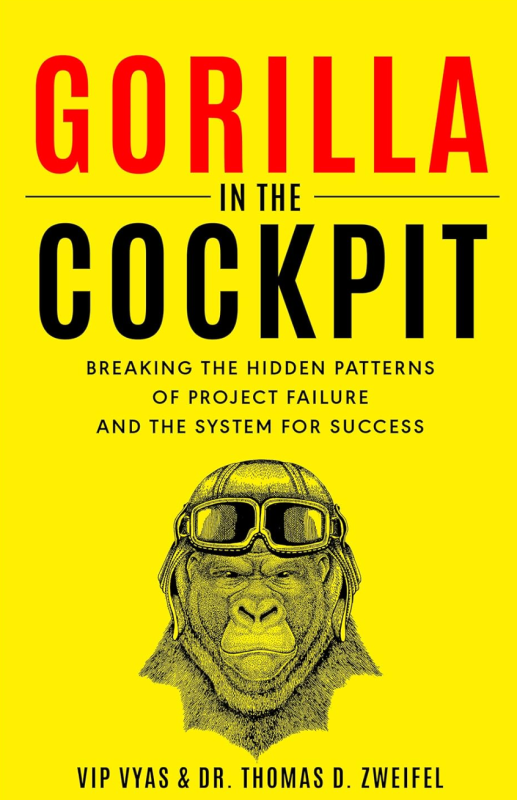
Gorilla in the Cockpit is designed with the reader in mind. A good-sized typeface and consistent features, such as the Radar Alerts at the beginning of each chapter, make it easy to read and absorb the core ideas. The juxtaposition of black and yellow on the three-color cover is a classic combination that creates strong visual impact.
The book aligns closely with current trends in project delivery, particularly its emphasis on the neuroscience of collaborative working, the shifting expectations of leadership, and the increasing importance of complexity science and systems thinking. These themes reflect how project environments are evolving globally and encourage readers to view success and failure as shaped more by mindset, behaviors, and systemic patterns than by technical processes alone. This shift from procedural thinking to systems- and behavior-aware thinking is timely and highly relevant, especially as projects increasingly operate in fast-changing and interconnected contexts where adaptability is key.
While the book refers to megaprojects, this framing is not essential to its message and may even risk deterring readers who do not work on large-scale projects. In practice, its principles and insights are universally applicable to all types and sizes of projects. The authors emphasize that even simple projects become complex once people, culture, and multiple perspectives are involved. This reinforces that its core relevance lies in exploring the human, cultural, and cognitive dimensions that influence decision-making and performance, factors that affect every project context. By focusing on why issues arise, not just how to follow processes, the book delivers timely insights that apply across sectors and geographies, wherever projects involve people and complex interactions.
The book is well-written, with strong storytelling elements, accessible language, and a good mix of case examples, intuitive frameworks, and research references that lend credibility to the authors’ arguments. The tone and style are well-pitched for the intended audience: leaders and decision-makers responsible for translating strategy into delivery and overseeing complex initiatives. The use of analogies (e.g., cockpit, flight path, radar) helps make abstract concepts more concrete, although the sheer number and mixing of metaphors can at times feel overextended or inconsistent.
The opening story about the Boeing 737 MAX is lengthy and may not immediately capture the attention of all readers. It occupies several pages and risks disengaging those expecting the book’s central ideas to appear sooner. Engagement tends to increase once the authors begin exploring the neuroscience and cognitive aspects of project leadership. The impact would have been stronger had these sections appeared earlier or if the first story had been shortened. In general, some of the stories could have been slightly more concise, leaving more space for the neuroscience and behavioral analysis that is the book’s real strength.
That said, the storytelling style makes the content accessible to readers who enjoy narrative approaches, and those who connect with the stories will likely find them a compelling way to grasp the book’s core ideas. The trade-off is that readers who do not find the initial stories engaging may risk disengaging before reaching the deeper conceptual material, which would be unfortunate given the quality of the insights that follow.
The book is clearly written by two authors with deep experience in the world of complex megaprojects, and it reflects a strong understanding of the challenges and frustrations faced by those leading them. The book provides substantial value, offering perspectives and insights that can help experienced practitioners reframe how they approach project dynamics. However, its practical utility depends heavily on the reader’s level of experience. More junior or less experienced practitioners may find it less immediately actionable, as it does not provide step-by-step methods or procedural checklists.
Instead, the book encourages readers to question assumptions and explore the “black box” of hidden drivers, beliefs, biases, attitudes, and cultural norms, contrasted with the “white box” of visible processes, metrics, and controls. This framing is insightful and aligns with real-world project leadership, where understanding unseen factors often makes the difference between success and failure. At the same time, the book leaves much of the application to readers themselves, requiring them to work out how to adapt and reengineer systems, processes, and organizations within their own contexts.
Case studies help ground these ideas, but they can feel overly long and verbose, which may dilute their practical impact. Similarly, conceptual diagrams such as the crash factors and black box/white box models are valuable but presented in small, monochrome visuals that reduce their clarity and visibility. Enlarging or colorizing these diagrams would enhance their accessibility and learning impact.
Overall, the book offers meaningful practical value for senior practitioners who can engage with its conceptual depth; however, its lack of prescriptive guidance means its applicability is moderate, particularly for less experienced readers.
The book successfully weaves together established and emerging ideas, offering a distinctive reframing of project leadership that integrates commercial, technical, and psychological perspectives. This is one of its strengths: it manages to be conceptually bold while remaining grounded in well-established models and thinking. Particularly innovative is the way the book employs an extended aviation metaphor, most notably the “gorilla in the cockpit” title analogy, the flight path metaphor, and the black box versus white box framework, where the white box represents visible processes and outputs and the black box captures the hidden psychological, cultural, and cognitive dynamics driving project outcomes. This framing is unusual in the project management literature and helps distinguish the book from more conventional, process-driven texts.
Much of the illustrative material, however, comes from construction-related megaprojects (e.g., the Sydney Opera House and other large infrastructure examples). While the authors use the term “megaprojects,” this framing may inadvertently narrow the perception of the book, as its principles could equally apply to large-scale initiatives in other domains, such as the Human Genome Project or the development of large language models in AI. Drawing from a wider range of industries would have strengthened its innovative impact.
Overall, the book’s novelty lies less in presenting entirely new knowledge and more in synthesizing existing but often non-mainstream ideas, such as biases, neuroscience, and cognitive framing, into a coherent and accessible narrative. This makes it feel fresh to mainstream readers, even if many of the individual concepts have appeared elsewhere. This explains its mid-level score (6): it reframes known concepts engagingly but does not fully break new ground in terms of underlying theory.
The authors’ selection of case studies reflects their background and experience, with a mix of familiar and less well-known examples drawn from various countries and cultures that give the book an international dimension. The cases are presented in both short and expanded formats, varying the pace and making the content more accessible. However, the selection reveals a natural bias toward megaprojects in infrastructure, construction, and engineering. A future edition could be strengthened by including more examples from social, environmental, digital, or other complex projects to balance this perspective and illustrate the universal applicability of the ideas discussed.
The book is highly integrative, with case studies forming the backbone of its structure and narrative. The authors consistently link their examples to the overarching “gorilla in the cockpit” metaphor, showing the emergence of hidden human and systemic factors at different stages of project delivery. They also connect these cases to their black box versus white box framework, reinforcing how surface-level issues often mask deeper cognitive, cultural, and behavioral dynamics. While sometimes verbose and construction-heavy, the case studies are used effectively to support the book’s core arguments. Broadening the scope beyond construction-focused projects to include complex initiatives from other industries would further enhance the relevance and balance of the case evidence.
Vip Vyas and Thomas D. Zweifel are experienced practitioners rather than traditional academics. They demonstrate a strong grasp of the literature and draw on research in imaginative ways, while their CVs highlight substantial experience in real-world project delivery. One author operates across several countries and is recognized at senior levels, including government level, in the UK and Hong Kong. The other is well known in German-speaking regions (Switzerland and Germany) and has appeared in public forums such as television and TED Talks.
Although not positioned within mainstream academic project management, they are prominent figures in the international project leadership community. This helps explain why the book is more suited to senior, reflective practitioners than to junior audiences. Their association with Bent Flyvbjerg and other leading voices in the megaprojects domain further strengthens their credibility, reinforcing their legitimacy and standing in the field. While this does not in itself validate every argument, it enhances the authority and influence of the book through their networks, visibility, and reach.
This is a well-judged and well-executed book, offering both intellectual depth and an engaging reading experience. It is designed not only for enjoyment but also for meaningful impact, striking a balance between personal leadership development and the organizational and project-level challenges practitioners face. Its greatest value lies with more experienced or senior professionals, given its focus on questioning assumptions, examining cognitive biases, and addressing the “black box” drivers of project outcomes.
The book encourages fresh perspectives and new thinking habits, helping readers step back from procedural approaches and reconsider the human and systemic factors that shape success and failure. In doing so, it delivers on its aim: to provide intellectual and emotional catalysts for evolving practice. While it demands more effort than a typical process-oriented project management book, it rewards readers with deeper insights and long-term relevance, making it a worthwhile investment of both time and money.
The use of research and references is appropriate and well balanced. There is enough to give the arguments credibility and to provide the interested reader with a springboard for further reading and study, should they wish to pursue it. At the same time, this is not intended as an academically rigorous text. The authors present their frameworks and their “10 Checks,” but then invite readers to use their own experience and mindset to validate what is being said.
The idea behind the visuals is sound, but the execution undermines their effectiveness. Inadequate resolution makes some of the text difficult to read, and the figures lack sharpness and precision. The use of icons feels more decorative than informative. For example, Figure 4.1 (“People vs. Technical Issues”) is difficult to interpret and does not clearly convey its intended message.
Future editions could benefit from clearer, higher-quality visuals, along with in-text references that integrate the figures more effectively with the narrative. This would enhance both clarity and value for readers.