






Book details
-
Publisher
SENTIENTE
-
Date of Publishing
July 25, 2024
-
Book size
354 pages
-
Format
Paperback & Kindle
Rating

About the book
In an era where sustainability is no longer optional, Green PMO – Leading the Sustainable Project Revolution serves as an essential guide for project managers. This timely book is a call to action, emphasizing the critical role project managers play in embedding sustainability into the core of their organizations.
The idea for the book originated from Eman Deabil, who deserves special recognition for her tenacity and insight. She brought together a group of experts united by a shared goal: to redefine project management through a sustainable lens. Her efforts in curating the content and initiating the Green PMO model reflect strong dedication to sustainable change and global collaboration.
The book revolves around two key themes. Firstly, it explores the operational integration of sustainability in project management. Chapters such as PMOs Driving Sustainable Value and The Integration of ESG to Address the Challenges and Potential Impacts of Digital Transformation delve into aligning project initiatives with environmental, social, and governance (ESG) criteria and implementing practical frameworks within daily project operations.
Secondly, it addresses the strategic dimension of sustainability in project management. Chapters like Strategic Conscious Leadership: How Project Intelligence Shapes the Future of the PMO and Agile and Green: Adapting Agile Methodologies for Sustainable Project Management offer broader perspectives on how methodologies like Agile can support sustainability goals. These sections provide not only insights but also actionable roadmaps for sustainable project leadership.
Green PMO – Leading the Sustainable Project Revolution stands as a comprehensive resource for project managers aiming to lead their organizations toward a sustainable future. The book marks a significant contribution to the field, empowering professionals to become agents of meaningful and lasting change.
AIPMO Review
Rating: 4.5 – This edited volume presents a collection of chapters exploring the integration of sustainability into project management, specifically examining the evolving role of the PMOs in enabling sustainable practices.
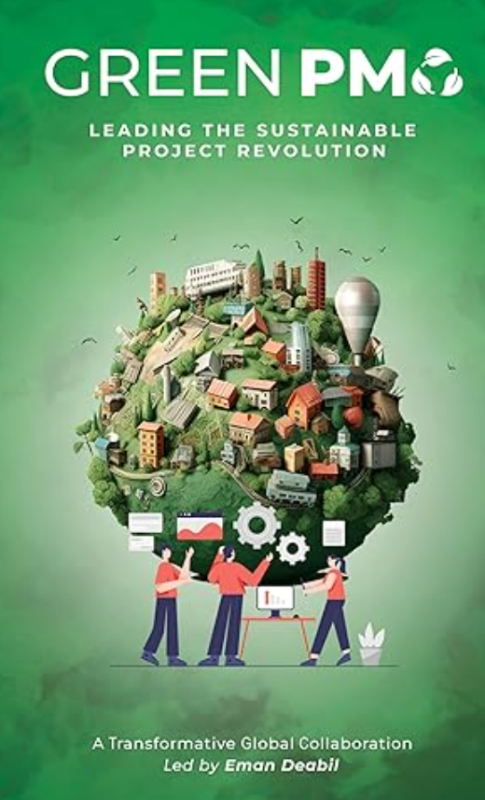
The cover effectively symbolizes this intersection with a visually appealing illustration of a planet surrounded by eco-friendly structures, reflecting the growing importance of environmental responsibility in project management.
Despite the promising premise, the book struggles with consistency and depth. The topic’s overall relevance is clear; sustainability and PMOs are timely subjects. Yet, fewer than a quarter of the chapters directly connect PMOs to sustainable development, diluting the book’s stated focus. Although some authors offer concrete insights into the PMO’s role in sustainability, most discuss sustainability within a broader project management context, thereby missing an opportunity for a deeper exploration.
The book’s readability suffers notably from structural inconsistencies and a lack of cohesion. Chapters vary significantly in length and internal structure, and although each generally includes author details and conclusions, the volume lacks a unified narrative framework. The absence of smooth transitions between chapters hampers the reader’s engagement and makes it challenging to follow the central arguments.
Visual elements such as graphs and tables enhance individual chapters but suffer from inconsistency across the book, weakening their potential to clarify complex concepts and engage readers fully. The inclusion of diverse case studies from the healthcare, IT, tourism, and infrastructure sectors adds value. However, these examples rarely showcase the direct involvement of the PMO, which limits their effectiveness in fully supporting the book’s central claim.
The book does not significantly expand existing knowledge or present a unique perspective on sustainability within project management. Although some chapters reference recent scientific literature, a more rigorous and comprehensive literature review could improve the overall research quality. This shortfall diminishes the publication’s potential scholarly impact. Nevertheless, for readers new to sustainability, the book provides a useful initial overview of key issues and methodologies, including ESG criteria and SDGs.
In summary, while the book engages with the topic of sustainability in project management and highlights its importance, it offers only limited guidance on how PMOs can drive and support sustainable practices.
AIPMO 10-point scale
The book design reflects the growing movement toward integrating sustainability into project management practices. The cover illustration features a planet surrounded by eco-friendly buildings and infrastructure, symbolizing a world where projects are conceived with environmental responsibility in mind. The book includes an attractive title page, contributing to a cohesive visual identity.
Sustainability in project management and the PMO role are not new topics. However, the ongoing academic and practical debate about the PMO’s contribution to achieving sustainable development goals is relatively recent. While the book’s title suggests a focused exploration of this critical intersection, most content does not fully align with this central theme. Fewer than a quarter of the chapters explicitly connect PMOs with sustainable development, while the majority discuss sustainability in project management more broadly.
While the editor undertakes the important task of bringing together diverse voices and writing styles, the final publication reveals challenges in achieving full cohesion and consistency across the chapters, particularly in effectively connecting the discussed topics with contemporary scientific advancements in sustainability within project management. Using a standardized scale designed to identify common editing issues, reviewers noted that this publication, unfortunately, exhibited multiple fundamental errors.
Moreover, the authors missed the opportunity to critically evaluate established methodologies, standards, and project management frameworks through a sustainability perspective.
The inconsistent structure and varying chapter lengths negatively affect the coherence and readability of the volume. While individual chapters maintain some internal consistency—usually including a conclusion and information about the authors—the book lacks a clear, unified organizational framework. This fragmentation results in a collection of loosely connected papers rather than a cohesive narrative. The disjointed flow and abrupt transitions between chapters significantly hinder reader engagement and obscure the primary messages of the publication.
The book offers limited practical application in real-world settings, as the content generally lacks depth and detailed guidance, making it challenging to implement effectively within its professional field. While several chapter authors present case studies describing specific projects and activities aligned with the principles of sustainable development, none of these examples demonstrate how the PMO functions as “the nerve center of project management and sustainability,” as claimed in the opening sentence of the book’s introductory chapter.
While the book makes some incremental additions to existing knowledge, it does not offer a unique perspective or significantly impact the field.
While some authors explore the role of PMOs in the context of sustainability, these discussions remain relatively limited. Most chapters lack significant value compared to the existing literature that connects project management with sustainable development. Consequently, the authors have missed an opportunity to illustrate how the PMO can equip project managers with the necessary tools to contribute to sustainability efforts.
The case studies presented offer a diverse range of early examples of integrating sustainability into projects across sectors such as healthcare, IT, tourism, energy, social services, and infrastructure. While this variety provides an engaging overview, the section falls short in one key area: it lacks high-quality examples that illustrate how sustainability is embedded specifically within PMOs.
This is a notable gap, especially given the book’s central claim that the PMO plays a pivotal role in driving sustainability in projects. Despite this, the included examples may still prompt readers to reflect on and discuss the PMO’s potential role, even if it is not explicitly addressed in the case studies.
The editor is well-known in the GCC countries and actively participates in conferences. The 39 contributors are mostly practitioners, except one or two academics. A few are recognized and frequently cited experts in the field of sustainability within project management.
This book provides a helpful introductory overview of the subject for readers new to sustainability, offering a gateway into key sustainability issues within project and PMO management. However, it falls short in providing the depth of knowledge necessary for significantly enhancing the understanding of practitioners already involved in sustainability or project management. This limitation could have been effectively addressed by adopting a consistent framework or structured approach, enabling clearer linkages between chapters and supporting a more cohesive development of understanding.
Nevertheless, the book summarizes current sustainability topics, highlighting specific methodologies, ESG (Environmental, Social, and Governance) criteria, the SDGs (Sustainable Development Goals), and practical examples of sustainable projects. These elements may inspire readers to further investigate areas of personal interest and explore additional literature.
The authors reference some recent scientific studies and sources in the field, but a thorough literature review is lacking. They do not provide a comprehensive overview of the latest scientific and professional literature, nor identify open questions or attempt to address them in a structured way. The inclusion of consistent recommendations for further reading at the end of each chapter would have considerably strengthened the book’s value for readers seeking deeper engagement with the topics introduced. The existing chapters could have gained greater significance within the context with minor revisions.
Some chapters include visual elements such as graphs, tables, and illustrations. These visuals are logically connected to the content and enhance individual chapters, but there is a lack of coordination among the authors. As a result, the visuals are not fully utilized to improve understanding or engage the reader as effectively as possible.