






Book details
-
Publisher
Harvard Business Review Press
-
Date of Publishing
January 15, 2013
-
Book size
192 pages
-
Format
Paperback, Hardcover, Kindle, & Audiobook
Rating

About the book
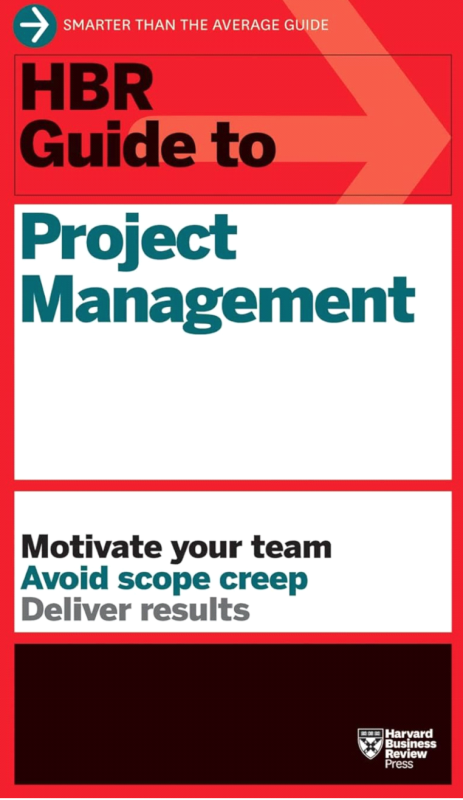
How do you rein in the scope of your project when you’ve got a group of demanding stakeholders breathing down your neck? How do you map out a schedule everyone can stick to? How do you motivate team members who have competing demands on their time and attention?
Whether you’re managing your first project or tired of improvising, this guide will give you the tools and confidence to define smart goals, meet them, and capture lessons learned so future projects go even more smoothly.
The HBR Guide to Project Management provides essential guidance on effectively managing projects. It helps you build a strong, focused team, break significant objectives into manageable tasks, and create a structured schedule to keep all moving parts under control. It also emphasizes monitoring progress toward goals, managing stakeholder expectations, and successfully wrapping up projects while assessing their overall success.
AIPMO Review
Rating: 7.3 – The HBR Guide to Project Management is a good book for mid and senior project managers who want to oversee a project at a glance and gain access to numerous best practices in a highly condensed format. The book presents a straightforward solution-oriented approach to project success, as promised in its blurb.
This pocket-sized book offers a highly practical and user-friendly format, ideal for experienced professionals seeking quick, actionable solutions. With professional typography and clear structure across 21 chapters by various authors, it delivers concise insights into common project challenges and best practices. Its strength lies in brevity, offering essential guidance using only the most necessary words. The book presents straightforward solutions and emphasizes critical project touchpoints, making it a handy reference for senior project managers.
As this book was published in 2013, it does not account for emerging trends like digital transformation and the growing influence of AI in project management. These evolving areas have since become integral to shaping the future of the field.
The book’s content remains generic, serving more as a standard reference than a guide to emerging practices. While it provides value through its clear, lean presentation of best practices, it omits deeper explanations, examples, or templates—limiting its utility for beginners or less experienced readers.
The book’s minimal use of visuals, such as tables and models, aligns with its concise style but may hinder engagement for visual learners. Enhanced visual elements could improve comprehension and appeal.
The Harvard Business Review’s global reputation adds credibility to the book, and its authors are well-respected professionals in the field.
Overall, it excels in providing simplified yet effective guidance for experienced practitioners but may fall short for audiences requiring detailed explanations or theoretical depth.
We did not score the “Case studies” and “Research quality” categories, as they do not apply to the pocketbook’s format. The book is intentionally designed to deliver concise, practical guidance rather than detailed examples, narratives, or in-depth analytical content.
AIPMO scale
The book’s pocket-sized format is both practical and user-friendly, allowing for easy reference on the go. The professional typography and clear structure enhance readability with a thoughtful hierarchy of headings and subheadings. The book is structured in 21 chapters written by a range of authors.
The book addresses standard project management challenges, offering practical solutions for daily work. However, as the book was published in 2013, it fails to explore emerging trends such as digital transformation or AI-driven project management tools, which are reshaping the industry. The content remains generic. Its global relevance is high, but more as a standard reference than as a source of information on changing trends or academic insights.
The book presents in the shortest possible way a straightforward solution concept to bring projects to success, as they promise in their book blurb. The presentation of the best practices is lean and well-structured. The book does not explain in detail why the mentioned points should be checked, but it emphasizes precisely the right spots and describes clearly and refreshingly the reality of project best practices. The book would be appealing to experienced professionals seeking quick solutions. Its utility is limited for beginners, lacking detailed explanations of key concepts.
High in applicability, the book does not aim to be comprehensive but provides immense know-how in concise words, showcasing best practices. It is extraordinarily clever and lean. Only the most necessary words are used to explain the problem and how it should be solved. The book provides a quick reference for experienced professionals, but juniors or less experienced readers might struggle to implement the solutions due to the lack of detailed explanations. While the foundational concepts are stated exceptionally well, providing additional examples, templates, or case studies would enhance its applicability across varying levels of expertise and industries.
Although the book should be commended for its ability to deliver practical and actionable insights within a concise format, it does not introduce groundbreaking concepts in project management. Its novelty and usefulness lie in its ability to convey key ideas concisely without the density and weight of academic papers.
We didn’t score the “Case studies” category, as it’s not applicable to this pocketbook’s format, which prioritizes concise guidance over detailed examples or narratives.
The Harvard Business Review’s global reputation for defining business standards lends significant credibility to this book. Contributors to this edited volume include Loren Gary, Gary Klein, Ron Ashkenas, Melissa Raffoni, Tom Cross, Jon R. Katzenbach, Douglas K. Smith, Nadim F. Matta, Ray Sheen, Clayton M. Christensen, Matt Marx, Howard H. Stevenson, and Jimmy Guterman.
The book focuses on practical problem-solving and keeping promises. It is a great resource for senior project managers who want to oversee a project quickly and receive extensive guidance and best practices in a highly condensed format.
It is also interesting for academic researchers, as it presents project management at an exceptionally concise level. However, the brevity can be a drawback, as readers need significant expertise to fill in the gaps and fully utilize the knowledge provided. This may limit its value for beginners who require more in-depth explanations.
Given its practicality and alignment with standard project management challenges, the book offers excellent value for its cost, particularly as a quick reference guide.
We didn’t score the “Research quality” category, as it’s not applicable to this pocketbook’s format, which intentionally excludes in-depth analysis to focus on quick, practical support.
The book includes a limited number of visual elements, such as tables and models, which are appropriately aligned with the content. However, compared to similar resources in the field, the book’s reliance on text over visuals makes it less engaging, particularly for visual learners. Including additional and more impactful visualizations, such as flowcharts or infographics, could enhance both comprehension and reader engagement.