






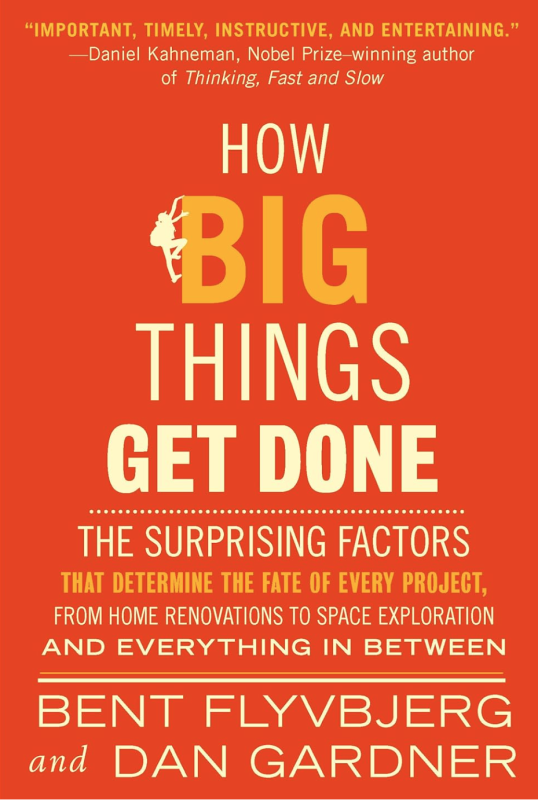
How Big Things Get Done
Book details
-
Publisher
Crown Currency
-
Date of Publishing
February 7, 2023
-
Book size
304 pages
-
Format
Paperback, Hardcover, Audiobook, and Kindle
Rating

About the book
• Plan slow, act fast. Getting to the action quick feels right. But it’s wrong.
• Think right to left. Start with your goal, then identify the steps to get there.
• Find your Lego. Big is best built from small.
• Be a team maker. You won’t succeed without an “us.”
• Master the unknown unknowns. Most think they can’t, so they fail. Flyvbjerg shows how you can.
• Know that your biggest risk is you.
Packed with vivid examples ranging from the construction of the Sydney Opera House to the creation of Pixar blockbusters and a home renovation in Brooklyn gone wrong, How Big Things Get Done reveals how to complete any ambitious project on time and within budget.
AIPMO Review
Rating: 8.7 – The book How Big Things Get Done by Professor Bent Flyvbjerg and Dan Gardner excels in its clear and logical presentation of ideas, supported by extensive use of examples and real-life case studies. Each chapter introduces new tools to aid reader success, systematically addressing potential criticisms and counter-arguments. The book offers fresh perspectives on slow, deliberate planning, rapid execution, and modularity, emphasizing reference-class forecasting, risk management, and a modular approach.
Professionally published in black and white with only a few graphs, the book uses a single font size throughout, except at the start of chapters, making the text appear somewhat monotonous. However, it is available in various formats, including hardcover, paperback, Kindle, and audiobook, catering to diverse reader preferences.
This book is extremely relevant given the high rate of failed projects worldwide. It emphasizes the need for a new approach to managing megaprojects, arguing that continuing with the same methods will yield the same unsuccessful results. Based on extensive research and data analysis from thousands of projects, the book offers a clear and logical direction to increase the number of successful projects.
The author presents ideas clearly and logically, using extensive examples to illustrate theoretical concepts. Each chapter introduces new tools to help readers succeed in their projects. The continuous integration of real-life case studies makes applying the theory to one’s projects easier. The author systematically addresses potential criticisms by examining the projects of those who oppose his ideas, demonstrating why certain approaches should not be copied.
Notably, the author explains the fat-tail distribution regarding time and budget overruns for megaprojects. He advocates for slow, deliberate planning followed by rapid execution and the use of modularity, which are fresh perspectives in the current age of agile thinking. The book is enriched with numerous relevant and recognizable case studies that help clarify key points.
Professor Bent Flyvbjerg of the University of Oxford, a leading expert in megaprojects, has consulted on over one hundred such projects and has published extensively on the topic. According to KPMG, Professor Flyvbjerg is the world’s foremost megaproject expert. The book underscores the importance of reference-class forecasting, risk management, and a modular approach, integrating innovative strategies like Pixar planning and reverse thinking (thinking from right to left).
The book’s robust research is supported by over 600 bibliographic references and more than 250 notes. Although it contains few graphs and tables, the ones included—such as those illustrating cost overruns and project type distributions—aid in understanding the content. Additional visuals could enhance the book’s attractiveness further. Overall, this book is a prime example of high-quality research, providing valuable insights and practical advice for anyone responsible for managing megaprojects.
It is a must-read for those seeking to improve their project management skills.
AIPMO 10-point scale
The book is professionally published in black and white. There are only a few graphs, and except for the beginning of the chapter, only one font size is used, so the text could look a bit monotonous. The book spans over 280 pages, with an unusual design that includes 100 pages of appendix, additional notes, and bibliography. It caters to diverse reader preferences in hardcover, paperback, Kindle, and audiobook formats.
The book is extremely relevant, looking at the number of failed projects worldwide. If we continue to do what we are doing, we get what we always got: an unsuccessful project. We have to change the way we run megaprojects. This book, based on many years of study and data analysis from thousands of projects, gives a direction to follow and increase the number of successful projects.
The ideas are presented clearly and logically, and the use of examples makes it easy to read and absorb the theory. Each chapter adds a new item to your toolbox, helping you become more successful. The consistency in tone, style, and structure throughout all the chapters adds to the book’s clarity and flow, making it a delight to read and absorb.
Because the theory is continuously accompanied by real-life case studies, it makes it easier to apply it to your own projects. The number of dials that can be turned is manageable, and each is dealt with one by one, allowing them to be used within their own context. Additionally, the author’s examination of how critics approach his ideas helps readers understand why these opposing viewpoints should not be adopted.
The book boldly questions traditional practices, encouraging readers to rethink their assumptions and embrace new ways of thinking. The author’s explanation of the fat-tail distribution in comparison with time and budget overruns for megaprojects, his approach of planning slowly before acting quickly in delivery, and his use of modularity are fresh perspectives in this age of agile thinking.
Throughout the book, you can find many relevant and recognizable case studies that support the theory. These case studies make it easier to understand the author’s key points. The diversity of case studies reflects the wide range of domain examples covered throughout the book.
The University of Oxford professor Bent Flyvbjerg is well-known in the field of megaprojects. He has studied these projects for many, many years. He has consulted on over one hundred megaprojects. He has many publications regarding this topic behind his name (> 50). According to KPMG, he is the world’s leading megaproject expert.
If we look at the number of projects running worldwide, and the total amount of current cost overruns, it becomes clear we have to run projects differently. If you are accountable or responsible for a megaproject, this book can help you succeed. Highlighting the importance of reference-class forecasting (coined by Bent Flyvbjerg), risk management, and a modular approach, the book integrates innovative strategies like Pixar planning and thinking from right to left.
The book highlights relevant examples underpinned by robust research across the different chapters of the book to support the theoretical part. They help in enriching the reader’s understanding and engagement. This book is an example of high-quality research. It is based on a bibliography of more than 600 books. Throughout the text, you get more than 250 references/notes.
There are not many graphs and tables throughout the book. The ones presented help to better understand the content, e.g., a table with cost overruns and project types versus fat-tail—thin tail distribution. More visuals could make the book even more attractive.