






Book details
-
Publisher
Routledge
-
Date of Publishing
April 28, 2012 (Paperback) June 28, 2017 (Hardcover)
-
Book size
184 pages
-
Format
Paperback, Hardcover, & Kindle
Rating

About the book
The concept of sustainability has gained significant recognition and importance. Companies increasingly face pressure to expand their reporting and accountability from purely economic performance for shareholders to sustainability performance for all stakeholders, driving a shift in consumer behavior and corporate strategies. How can we achieve prosperity without compromising the lives and needs of future generations? Sustainability in Project Management examines and addresses the challenges of integrating sustainability principles into projects and project management, offering valuable guidance and insights. Sustainability encompasses multiple dimensions—economic, environmental, and social—while also relating to responsibility, accountability, and values such as ethics, fairness, and equality. The authors encourage project managers to be mindful of these considerations and to incorporate them into their roles, focusing not just on “doing things right” but on “doing the right things right.”
AIPMO Review
Rating: 7.7 – The book Sustainability in Project Management offers a comprehensive and practical guide to integrating sustainability into project management practices. It provides a detailed analysis of sustainability principles and actionable insights that can be applied in real-world situations, enabling readers to implement strategies with measurable results. The content is well-structured, starting with fundamental concepts and gradually delving into their application within project management. Each chapter builds logically, making it easy to follow, and the organized sections enhance readability. The book’s global relevance is underscored by its incorporation of international standards like ISO 26000 and the Global Reporting Initiative, making it applicable to various industries and sectors. Additionally, while the book offers valuable insights, it focuses on case studies from developed economies. There is an opportunity to expand on perspectives from developing countries and emerging markets. Including more examples from these regions could enhance the relevance of the book’s insights for readers facing different socio-economic and environmental conditions.
The authors, particularly Gilbert Silvius, bring significant expertise to the table, though there is less visibility for some contributors on professional platforms. Despite this, the book remains a well-researched resource, offering practical advice rather than groundbreaking innovations. Its focus on professional development and structured guidance makes it a strong technical resource, though it lacks motivational content or personal development elements. At the end of each chapter, a list of references provides further reading, enhancing its credibility.
In summary, the book is an essential tool for professionals seeking to integrate sustainability into their project management practices. Its clear, actionable guidance supports professional growth.
AIPMO 10-point scale
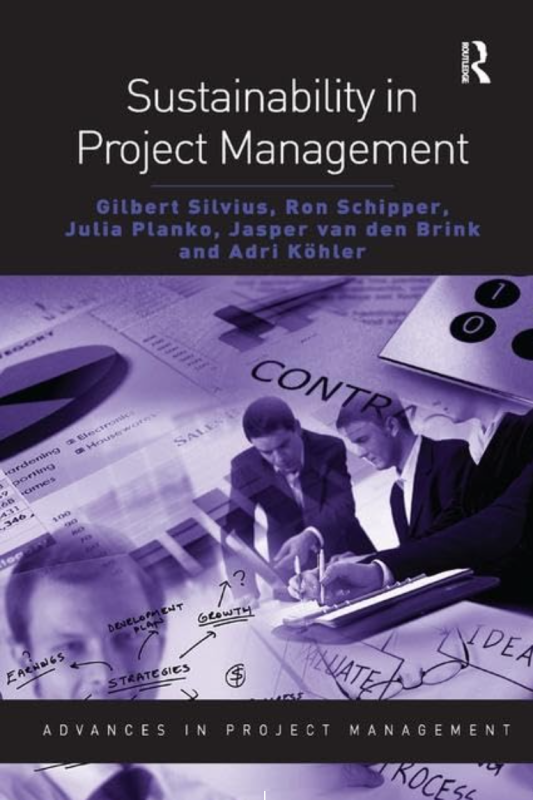
The cover is well-executed but could be more aligned with the topic. Inside the book, the black-and-white graphs hinder readability. Introducing color to these visuals would significantly enhance comprehension and engagement. Typography is adequate but could be refined for clarity.
The book explores sustainability principles and their application in project management, offering detailed discussions on how sustainability influences processes, competencies, and organizational practices. It moves beyond basic concepts to analyze the complexities of integrating sustainability into project management. Although published in 2012, with more topics emerging in project management, it still offers valuable guidance for today’s professionals. The book incorporates international standards like ISO 26000 and the Global Reporting Initiative, making its insights applicable worldwide. Its emphasis on balancing economic, environmental, and social considerations transcends cultural boundaries, providing practical advice for project managers in various sectors. The book’s call for professionals to integrate sustainability into their work highlights its enduring importance across diverse global contexts.
The book is thoughtfully structured, beginning with fundamental sustainability concepts and gradually integrating them into project management. Each chapter builds logically on the previous one, ensuring a smooth progression of ideas. Organized sections and summaries throughout the book enhance readability and accessibility, making it easy for readers to follow and absorb the content. The text is clear and professional, with minimal grammar and spelling errors, contributing to a polished and understandable presentation. The pacing and engaging content keep the reader invested, making the book informative and enjoyable.
The book offers a comprehensive analysis of sustainability in project management, combining practical tools, checklists, and an exploration of key principles. This approach improves practical application and deepens the reader’s understanding of how sustainability transforms project management. It equips readers with the knowledge to align project goals with sustainability objectives, enhancing decision-making for managers and stakeholders. Furthermore, it provides actionable steps for project managers, PMO leaders, and sponsors to integrate sustainability into their work. While some older standards are still referenced, they remain useful.
The book advances the integration of sustainability into project management, offering practical guidance rather than introducing groundbreaking innovations. Its strength lies in providing comprehensive insights and encouraging critical thinking, though it doesn’t radically shift existing norms or establish new standards.
The book successfully integrates its case studies with the overall arguments, providing comprehensive analysis and valuable insights. The examples presented are compelling and provide strong support for the key themes. While the focus is largely on case studies from developed economies, which offer important lessons, there is an opportunity to expand on perspectives from developing countries and emerging markets. Including more examples from these regions could enhance the global relevance of the book’s insights for readers facing different socio-economic and environmental conditions.
Gilbert Silvius is a well-established academic and practitioner with significant project management and sustainability expertise. He has authored three books and over 20 articles on the subject and holds academic positions at HU University of Applied Sciences Utrecht. Ron Schipper, a principal consultant and independent researcher at Van Aetsveld in the Netherlands, brings over 15 years of experience as a project manager focused on organizational change. He has also published over 20 articles related to sustainability. While Gilbert Silvius is highly regarded in the field, with notable academic contributions, there appears to be less visibility for the other contributors, particularly on professional platforms like LinkedIn.
The book delivers thorough and clear content on sustainability in project management, offering practical, actionable guidance for professionals. Though it contains some motivational aspects, the emphasis remains on providing relevant advice that supports professional growth and the successful integration of sustainability practices.
Overall, the book effectively uses high-quality visuals essential for understanding the content, providing clarity, and improving the reader’s comprehension. These visuals’ consistent and professional presentation adds to the book’s educational value. However, some figures are rather complex, and simplifying them could enhance the reader’s ability to grasp the topics more easily.