






Book details
-
Publisher
Springer
-
Date of Publishing
April 2, 2024
-
Book size
328 pages
-
Format
Paperback, Hardcover, & Kindle
Rating

About the book
This volume aims to explore the contributions of project management to sustainable business change, focusing on renewability, reuse, and repair, as well as the impact of circular economy business solutions on project management in terms of management approach, governance, and leadership. The main aim of integrating project management with a circular business paradigm is not only to learn how project management can contribute to achieving circular economy principles, but also to understand the impact of business needs on project management. By understanding these needs, recommendations can be developed and promoted among different stakeholders, such as governments, financial institutions, and educational institutions, with the goal of supporting and assisting project management to drive sustainable business change. This approach will enable readers to assess how project management professions can support a shift toward sustainable business. The primary audience of this work is management scholars, educators, researchers, and students. Scholars, government representatives, financial institutions, management educators, start-up companies, innovative entrepreneurs, and all others who use the circular economy to support sustainable development can also find much of use in this book.
AIPMO Review
Rating: 6.2 – Sustainable Business Change: Project Management Toward Circular Economy, edited by Dr. Vladimir Obradović, is a comprehensive collection of twelve scientific and professional chapters that connect circular economy principles to a wide range of business and management domains. The book explores themes such as procurement, human resource management, waste and materials management, corporate responsibility, strategic sustainability, and project portfolio management. Through these interconnected topics, it offers a multidisciplinary view of how organizations can transition from traditional linear processes toward more regenerative and sustainable models. The integration of project management throughout the volume provides a cohesive framework for understanding how circular economy concepts can be operationalized within organizational structures and decision-making processes.
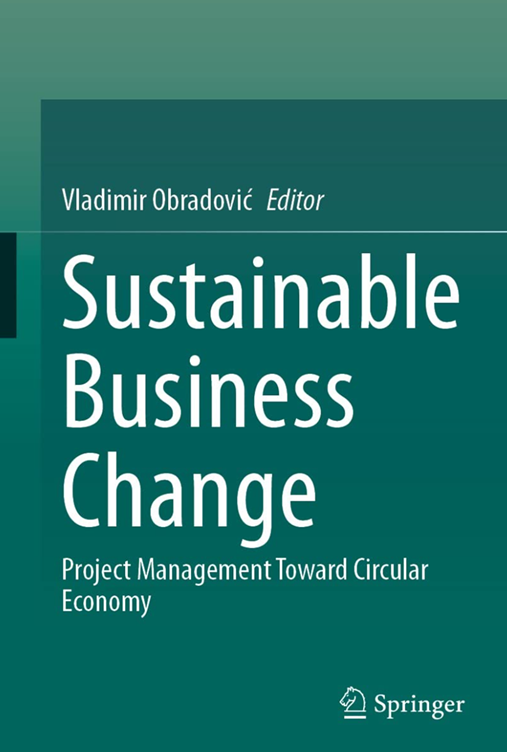
The typography, layout, and overall presentation follow an academic structure, with each chapter featuring abstracts, keywords, author details, and references. This formatting supports clarity and reinforces the scholarly nature of the work. The book cover is professional and aligned with the sustainability theme, though modest in creativity and visual innovation. While the design choices reflect consistency and seriousness, they offer limited distinction compared with other academic publications on sustainability or project management.
The content resonates strongly with current global sustainability dialogues, particularly those aligned with the UN Sustainable Development Goals and other international frameworks. Across the chapters, the circular economy is positioned as a strategic driver for organizational change, emphasizing long-term value creation, resource efficiency, and systems thinking. Despite this global relevance, the book maintains a predominantly academic and policy-oriented tone. The writing is technically sound and generally clear, yet some chapters could benefit from improved coherence, especially when shifting from theoretical analysis to practical implications or discussing project management challenges within circular contexts.
The book’s conceptual breadth is one of its key strengths. It draws on diverse perspectives to show how circular economy ideas influence decision-making, governance structures, and organizational behavior across industries. Among the more distinctive contributions is the exploration of system dynamics modeling and advanced analytical approaches for assessing the impact of project management on circular economic processes. This analytical dimension points to emerging opportunities for linking sustainability performance with project outcomes through simulation and data-driven decision-making.
However, the book leans more heavily toward literature synthesis than practical application. While several contributions challenge linear project management assumptions and reinforce the need for systems-based sustainability approaches, they primarily extend existing debates rather than introduce original frameworks or operational models. Case studies and real-world examples are included but tend to be brief, surface-level, or limited to European contexts. This narrow geographical focus, combined with the scarcity of detailed best practices and replicable tools, restricts the book’s practical value for a global practitioner audience.
The editor, Dr. Obradović, brings substantial academic credibility to the volume through his leadership in international project management organizations and his editorial experience in leading journals. The contributing authors span multiple technical and social science disciplines, enhancing the book’s interdisciplinary depth. The research base is extensive, supported by more than 1,000 citations, though primarily drawn from European policy documents and sustainability organizations such as the EU Circular Economy Action Plan and the Ellen MacArthur Foundation. This reinforces the book’s academic rigor but somewhat limits global perspective diversity.
Visual elements—including graphs, tables, and conceptual models—aid comprehension but vary in quality, formatting, and analytical contribution. Despite these limitations, the book remains a valuable resource for scholars, policymakers, and project professionals seeking foundational knowledge on circular economy integration. It provides a thorough conceptual grounding in sustainability and project management intersections, even if its practical and innovative depth remains moderate.
AIPMO scale
The book’s typography is simple and clear, with consistent fonts throughout. Each chapter follows the structure of a scientific paper, including abstracts, keywords, author details, and sources, giving the book a formal and organized appearance. The cover is simple and professional, in line with the publisher’s visual identity, and it clearly presents the title, uses a color palette aligned with the theme of sustainability, and maintains a professional aesthetic appropriate for an academic audience. While it does not exhibit a high degree of originality or visual innovation, it fulfills the essential requirements of clarity, thematic relevance, and professionalism.
The book is a collection of professional and scientific articles by various authors, encompassing twelve chapters that link the circular economy (CE) phenomenon to multiple domains, including higher education, human resource management, waste management, procurement in construction, corporate social responsibility, crowdfunding for startups, CE indicators, strategic sustainability, and impact assessment through the System Dynamics Model.
Several chapters explore the relationship between the circular economy and the management of projects, programs, and portfolios, highlighting a dynamic and increasingly significant area of research. The circular economy emerges as a compelling topic when viewed through the lens of cost-benefit analysis, environmental consciousness, legal and policy frameworks, measurement dimensions, and strategic business value. The book raises important questions and encourages further discussion and research in these areas.
The content demonstrates strong alignment with current global trends by addressing sustainability and circular economy practices. Its global relevance is reinforced through references to the UN Sustainable Development Goals and international sustainability frameworks, particularly in Chapter 1 – “The Role of Higher Education in Transition to a Circular Economy.”
This chapter stands out for its extensive treatment of global trends, explicit references to the UN SDGs, linking the circular economy to sustainability, incorporation and discussion of international frameworks, and clear establishment of the topic’s global relevance.
However, the focus remains primarily academic and policy-oriented rather than market-driven, as illustrated in the discussion on “cradle to cradle” approaches. The book relies largely on established concepts, such as its treatment of eco-efficiency in Chapter 6, and contributes more to consolidating existing debates than to shaping new ones.
The book contains twelve scientific articles written by different authors. Considering the number of contributors and the variety of topics, the language and writing style remain relatively clear and consistent throughout. Chapter lengths vary, and some lack visual elements such as graphs and tables. This is understandable, as many chapters primarily focus on literature reviews within their respective subjects, incorporating only a limited amount of original research.
The writing is technically sound but occasionally affected by issues in coherence and engagement, which hinder a smooth reading experience. A clear example appears in Chapter 4, where the transition between the discussion of project context and implementation challenges lacks logical connectors and bridging explanations. This results in fragmented flow and makes it more difficult for readers to follow the progression of ideas.
Nearly every chapter addresses topics that are highly relevant to current real-life practices connected to the circular economy. Subjects such as procurement, waste management in construction, and the measurement of circular economy outcomes are central concerns for many organizations in the manufacturing and construction sectors. Despite the relevance of these themes, the book contains limited original research, examples of best practices, and case studies that could strengthen its practical application. There is also a tendency to emphasize literature reviews over actionable, practice-oriented solutions.
A noteworthy example of practical value is found in Chapter 9, “The System Dynamics Model for the Impact Assessment of Project Management on Circular Economic Processes,” which demonstrates the potential of using simulation modeling—based on system dynamics and deep recurrent neural network modeling—to assess the impact of project management on circular economy processes.
The book provides moderate practical insights, particularly by linking project management with circular economy concepts. However, it lacks actionable frameworks or tools for direct implementation. While it helps clarify stakeholder roles in decision-making, it does not include structured decision aids or templates applicable across industries. Problem-solving guidance remains general, without presenting specific strategies or innovative approaches. For example, while the book emphasizes the importance of stakeholder engagement, it does not provide a detailed engagement plan or adaptable models for different sectors.
What makes this book unique is its integration of the circular economy concept—which, while not new, is examined across various business dimensions such as procurement, human resources, waste management, strategic planning, project management, and project portfolios. Its greatest value lies in its breadth of inquiry and its exploration of the circular economy and its ten elements from multiple perspectives.
In terms of contribution to existing knowledge, several chapters stand out by presenting original research or providing high-quality syntheses of existing studies with new organizational perspectives, particularly those addressing waste management in the construction industry. One chapter (Chapter 4) also examines the impact of individual and organizational characteristics on sustainable development goals through the lens of four tensions: Cognitive Dissonance in Organizational-Individual Responsibility, External Role Tension, and the Visibility of Values as reflected through procurement.
The content introduces new perspectives by linking project management with circular economy principles, yet it primarily builds upon established ideas rather than proposing novel frameworks (Chapter 1). It challenges traditional linear project management models by examining tensions between individual and organizational sustainability responsibilities in procurement practice (Chapter 4). The contribution to knowledge is incremental, integrating sustainability concepts into project management rather than extending theoretical foundations (Chapter 2). Most examples, including those related to circular economy indicators and sustainable practices, are drawn from familiar approaches and therefore display limited originality, due to a lack of up-to-date information (Chapter 6).
The book primarily focuses on literature review and includes only a limited number of case studies. One of the most notable examples appears in Chapter 4, titled “Responsible Project Management: Tensions in a Tier 1 UK Infrastructure Organization.” This chapter examines how different organizational and individual factors can create tensions or paradoxes as companies seek to minimize their environmental impact. Although the book references several case studies from other scientific publications, these do not substantially enhance its overall analytical depth.
The integration and quality of case studies throughout the book remain limited. While some real-life examples—such as sustainable construction practices in Chapter 3—add contextual relevance, they are presented briefly and lack detailed analysis or strong connections to the central arguments. The diversity of examples is also narrow, focusing primarily on European contexts and omitting broader global or cross-sector perspectives. Overall, the examples reinforce the narrative at a surface level but do not offer comprehensive or critically examined insights.
The book is written by multiple authors and edited by Dr. Vladimir Obradović, a respected expert in the field of organizational sciences and an active contributor to project management. He serves as the Vice President of the International Project Management Association (IPMA) and as Editor-in-Chief of the European Project Management Journal. Additionally, he is a member of the editorial board of the International Journal of Project Management.
The contributing authors represent a diverse group of scientists and professionals from various technical and social science disciplines, each with different levels of recognition and citation within their respective fields. This diversity enriches the book’s perspective and supports its interdisciplinary approach to circular economy and project management.
Dr. Obradović holds a Ph.D. and serves as a professor at the University of Belgrade, reinforcing his academic and professional credibility (noted in the author biography and Chapter 1 acknowledgments). His publication record includes several peer-reviewed articles and a limited number of books, supporting a moderate publication profile. While he actively participates in academic conferences, his social media presence and broader community engagement remain modest. The book benefits from his academic leadership and the collective expertise of multiple contributors, though its visibility beyond academic circles could be strengthened.
The book holds significant value within the field of the circular economy, offering a multifaceted perspective that connects the concept to various areas of business and project management. This makes it especially beneficial for professionals engaged in implementing and monitoring circular economy principles across industries, as well as for academics exploring sustainability and organizational transformation. To strengthen its impact, the book could include more research models that serve as foundations for further study and incorporate creative, practical applications within real-world sectors.
The content provides comprehensive coverage of sustainability and circular economy principles, particularly in Chapter 2, establishing a strong conceptual and learning foundation. However, the recommendations remain general and lack step-by-step guidance for implementation, as illustrated in the discussion on project sustainability integration in Chapter 4. While the book encourages a shift toward sustainable and systems-based thinking, its academic tone somewhat limits motivational appeal. Nonetheless, it contributes meaningfully to professional development by deepening conceptual understanding of sustainable project management and expanding awareness of circular economy practices.
This segment represents one of the book’s strongest aspects, featuring over 1,000 citations, particularly focused on the circular economy. The referencing style is generally consistent and well-structured, demonstrating strong academic rigor and a comprehensive research foundation. However, some chapters include a high number of self-citations or rely on older sources, which slightly reduces the overall credibility of the references. In certain sections analyzing circular economy indicators, citations referring to policy frameworks were already outdated at the time of publication, which diminishes the relevance and currency of the findings.
While the book draws from a wide range of source types, most references are concentrated within European contexts. For example, Chapter 2 places considerable emphasis on the EU Circular Economy Action Plan and reports by the Ellen MacArthur Foundation, with limited perspectives from other global regions or industries. This geographical and sectoral concentration restricts the diversity of viewpoints, affecting the broader applicability of the research. Despite these limitations, the book maintains a solid academic foundation and a coherent presentation of sources.
The book is a compilation of scientific and professional articles on the circular economy, featuring a relatively modest range of visual elements. Each chapter includes tables and graphs that illustrate selected data and research findings, along with graphical models such as the entropy model and the functional competence model presented in certain sections. These visuals help clarify key points and enhance the reader’s understanding; however, they lack consistency throughout the book, resulting in the absence of a cohesive visual identity. In some cases, the graphical resolution is poor, which further reduces visual quality.
Color figures are used to improve clarity and readability, and while they contribute positively to presentation, they add limited analytical value. The visuals largely reiterate textual content rather than introducing new insights, as seen in the circular economy diagrams in Chapter 9. In addition, the formatting, labeling, and color schemes vary across chapters, highlighting inconsistencies in editorial and design standards.