






Book details
-
Publisher
Anne-Marie C Sheehan
-
Date of Publishing
June 29, 2020
-
Book size
186 pages
-
Format
Paperback & Kindle
Rating

About the book
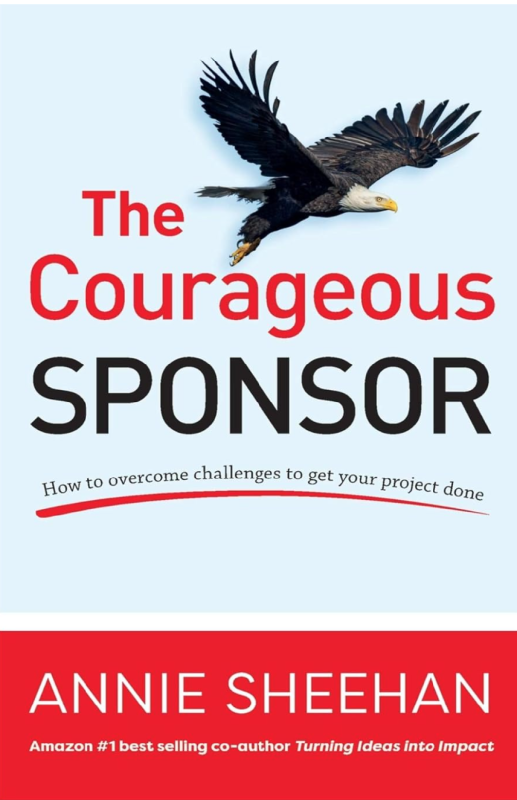
This book helps executive leaders understand what it means to be an effective project sponsor. Over the author’s long career as a project management professional, executive coach, and board director, she has worked with many experienced leaders who have been thrown into the project sponsor role. Many don’t know where to start or who to ask for help.
This book will help you understand an effective project sponsor’s fundamental skills and expected behaviors and the positive impact this can have on the team and the project outcomes. It is filled with examples, stories, and practical action steps to help the reader develop courageous sponsor skills.
The book covers essential topics for project sponsors, including understanding basic project terminology, managing sponsor behaviors, building teams, focusing on action, and developing project roadmaps. It emphasizes effective communication, courageous feedback, continuous improvement, and strategies to define success and execute plans.
AIPMO Review
Rating: 6.1 – Despite being a self-published volume, The Courageous Sponsor: How to Overcome Challenges to Get Your Project Done by Annie Sheehan is of high quality, featuring a clean format, clear and logical structure, and excellent presentation throughout. It addresses the well-recognized yet rarely tackled challenge of sponsors’ ability to lead projects effectively. The book is reader-friendly and easy to digest, avoiding technical jargon and bringing the content to life with its direct, conversational style.
With its highly accessible approach, including a sponsor-mode self-evaluation tool, practical instructions, and checklists, this book is a valuable addition to any sponsor’s library—particularly for those less familiar with the technicalities of project management. The work emphasizes a sponsor’s day-to-day behaviors and practical activities to ensure successful delivery rather than advancing theoretical concepts.
Suggestions for tasks within the ordinary day-to-day demands of the role—such as prioritizing, tracking roadmap delivery, ensuring effective project progress, and running retrospectives—are presented in a simple, easy-to-follow manner with useful explanations and actionable steps. Multiple scenario-based examples and relevant case studies further enrich the content, illustrating the recommendations and bringing the material to life.
AIPMO 10-point scale
The layout of this book is clear and easy to read, with an effective balance between the core text, highlighted sections of case study examples, helpful step-by-step how-to lists and tables, and white space on the page. The sizing of titles and mix of font choices can be a little distracting, and there is no color, but overall, the layout and readability are good.
The author provides sensible and practical advice for sponsors to reflect on how they currently and may in the future approach their role. The suggestions are based on current trends and contemporary good practices, for example, in effective Portfolio prioritization techniques shared or through suggested working methods such as daily scrum-style meetings, which the author refers to as “Project Drills.” So, the book does not set out to break new ground in the field but to simply and effectively explain current thinking on positive change leadership behaviors in a way that even a first-time sponsor could readily understand and easily implement. However, this helps fill an important and frequently referenced gap in effective management support for projects.
Pitched at non-experts, the text is easily readable and well-structured. Sentences are short, and no complex technical jargon is used. The content is broken into logical chapters with clear subheadings and a consistent overall flow that enhances understanding. The author addresses the reader directly: “First you must pause…” There is some unnecessary repetition, and the level of simplification may be unnecessary for the seniority of the audience; however, it does act as intended in keeping the book highly accessible and simple to pick up.
The content is highly practical and rooted in the real-life experience of a business manager becoming a sponsor. It is divided into three sections. “Prepare” helps the reader mentally and practically ready themselves to be a courageous sponsor. “Experiment” focuses on embracing curiosity and a learning mindset to achieve stability and make reliable progress. The final section, “Reflect,” emphasizes courage and vulnerability. It provides clarity and useful step-by-step descriptions of how, for example, project prioritization processes or project meetings might be run, giving leaders clear and actionable guidance. Covering matters such as establishing routines, soliciting feedback, running a retrospective, or defining a roadmap, it tackles the daily ways of working and interactions with the team.
This book takes a human behavior lens to project leadership. Initially, it sets up six archetypes of typical sponsor attitudes and behaviors. It invites the reader to assess honestly which one they most closely resemble, introducing a novel approach to the subject matter. The first persona, the Peacock, is a sponsor who can’t be counseled and shouldn’t be a sponsor. The book focuses on the four personas in the middle: the aggressive Magpie, the avoidant Ostrich, the curious Duck, and the effective Eagle. Finally, the Owl serves as the role model. Sponsors are encouraged to validate their self-assessed persona by obtaining feedback from their team. The project skills and tools recommendations are based on well-established norms within the project management profession, but what this book recognizes and attempts to address is that these are not necessarily known and obvious to the many non-project managers who are often the ones tasked with leading change in organizations.
A few “case studies” and short, simple illustrative examples reinforce the learning and recommendations within each section. Some are genuinely based on real-life projects from a variety of enterprises, including JBWere, Axa, and SpaceX, while others appear to be fictionalized and anonymized illustrative stories about Company A or “Magpie sponsor Kim” and anecdotes of the author’s personal experience drawn from a range of life and work scenarios.
Annie Sheehan is well-qualified in project management and related disciplines. She has been president of the Melbourne PMI chapter and has an established track record in international project delivery, agile, and executive-level coaching. This is her second book; the previous volume, “Turning Ideas Into Impact,” became an Amazon best-seller.
This book will be most valuable to managers new to project sponsorship. It can also be a tool for self-reflection and personal growth for more experienced change leaders. It effectively covers the fundamentals without going into deep technical details or getting lost in jargon.
This book is light on references and sources; however, where these are provided, they point to relevant and effective examples, such as psychologist Carol Dweck and respected voices in the leadership and self-development genre, including Stephen Covey and Simon Sinek.
There is limited use of visuals. Tables are the most commonly used format for representing additional information. However, the few additional graphics included are appropriate and adequate to illustrate the content effectively.