






Book details
-
Publisher
Page Two
-
Date of Publishing
September 10, 2024
-
Book size
336 pages
-
Format
Hardcover, Kindle, & Audiobook
Rating

About the book
Drive high-IMPACT business value with a game-changing strategy delivery system
ORGANIZATIONS must accelerate strategic results to thrive, and they need you in the driver’s seat. How do you achieve this, even when firefighting is the norm? With three decades helping organizations deliver change, 2021 World PMO Influencer Laura Barnard unveils the system she uses with clients and students to evolve stagnant project and transformation teams into nimble, business-driven delivery engines.
The IMPACT Engine is a comprehensive playbook that will help you accelerate business value, deliver sustainable change, drive higher ROI, increase stakeholder buy-in, and earn your place guiding organizational priorities.
Following the six-stage road map, you will embrace the IMPACT Driver Mindset, secure quick wins, and scale value while addressing shifting business priorities―the key to sustained relevance at the leadership table as the Strategy Navigator your C-Suite needs by their side. Packed with real-world examples and downloadable tools, this system will help you ignite high-performance delivery across the organization.
AIPMO Review
Rating: 7.3 – The Impact Engine by Laura Barnard offers a practical and structured approach to PMO transformation and strategy execution, with a strong emphasis on translating strategy into measurable business outcomes. The book addresses the strategy-to-execution gap, positions the PMO as a strategy delivery function, and shifts the focus from project outputs toward business impact. It is highly aligned with current trends in PMO and strategy execution, including Agile transformation, product-based operating models, and organizational transformation.
A key strength is the book’s clear and easy-to-follow presentation. Concepts are connected through a recurring narrative structure, including the Samantha/Alex examples, which show how PMOs can become trapped in templates, methodology, and the triple constraint before moving into the strategy lifecycle, MVP delivery cycle, stakeholder alignment, and IMPACT Driver mindset. This creates a logical progression from problem diagnosis to practical execution. The language is conversational and easy to understand for practitioners, although some repeated motivational phrasing and branded terminology slightly affect the overall readability.
The book also provides a clear, actionable direction for implementation. Readers are guided to assess the organization, involve stakeholders, define high-impact services, build a delivery model, focus on an MVP, and evolve through feedback. The “Make an IMPACT” sections and downloadable resources point readers toward action, while training and supporting programs provide further tools for implementation. However, many tools are provided outside the book, meaning that it is more of an actionable guide and roadmap than a complete, self-contained implementation toolkit.
In terms of innovation, the book does not introduce a wholly new discipline but offers a useful reframing of established PMO and strategy execution concepts. Its main contribution is the shift from process governance, templates, and on-time/on-budget control toward measurable business impact, strategy lifecycle coverage, MVP-based value delivery, and roles such as Strategy Navigator and IMPACT Driver. This represents a valuable synthesis and repositioning rather than a revolutionary methodology.
The book uses examples effectively, but most are illustrative or composite-style scenarios rather than rigorous real-life case studies with baseline data, intervention details, and measured outcomes. Real-life case studies would provide greater value by demonstrating actual implementation and measurable outcomes.
Laura Barnard brings substantial practitioner expertise and professional recognition, including her role as Founder and CEO of PMO Strategies, inventor of the IMPACT Engine System, podcast host, IMPACT Summit host, co-founder of International PMO Day, and 2021 World PMO Influencer of the Year.
The book supports professional growth through its emphasis on mindset shift, reflection, and roles such as IMPACT Driver, Strategy Navigator, Trusted Adviser, and Change Agent. However, the growth content remains relatively high-level.
Overall, the book is a strong practitioner-oriented resource, supported by credible industry research, although its research base is limited. Its visuals are clear and useful but relatively simple.
AIPMO scale
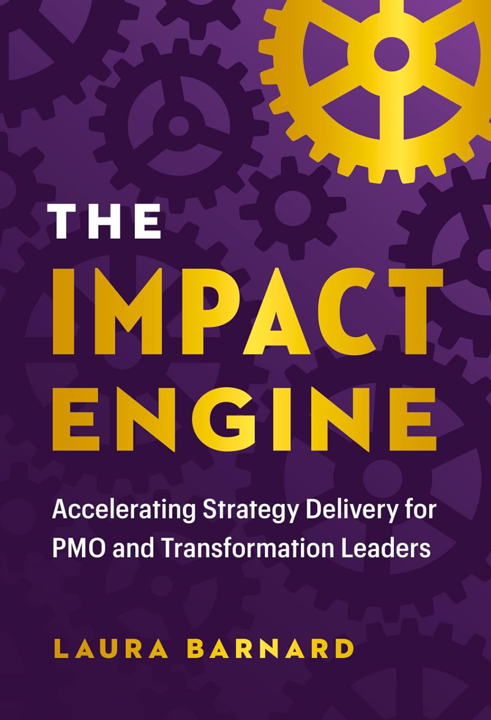
The design quality of the book is eye-catching, with an emphasis on design, clarity, and professional presentation. The book adopts a clean and structured visual approach, with consistent typography. The jacket of the book is appealing and impactful across both the front and back covers. The bold typography and structured layout signal a serious, practitioner-oriented book. However, the front cover is somewhat confusing, with several gears that do not appear to interact. The use of a prominent gear referring to the IMPACT Engine provides a clear connection to the book’s core concept.
The term “IMPACT Engine” is visually emphasized, prominent, and unambiguous, reinforcing the core value proposition. The presentation is professional and readable, with clear black-and-white interior typography and a simple chapter/section hierarchy. The typography supports reading effectively with consistent fonts, sizes, and spacing that enhance readability and visual appeal. The format is platform-compliant (Kindle/ePub), which enables a seamless experience for the end user.
The book is highly readable because it connects concepts through a recurring narrative structure rather than presenting isolated theory. The Samantha/Alex examples show how a PMO can become trapped in templates, methodology, and the triple constraint, then the text moves into the strategy lifecycle, MVP delivery cycle, stakeholder alignment, and IMPACT Driver mindset. This creates a logical progression from problem diagnosis to practical execution. The text exhibits strong coherence, seamlessly connecting ideas and maintaining a logical flow throughout. The language is conversational and accessible for practitioners, while the author’s structured and precise writing style ensures that complex concepts are communicated effectively. However, some repeated motivational phrasing and branded terminology prevent a perfect score.
The Impact Engine stands out for its practical utility, offering a structured and actionable framework that enables PMO and transformation leaders to translate strategy into measurable outcomes. The book gives readers a usable direction: assess the organization, involve stakeholders, define high-impact services, build a delivery model, focus on an MVP, and evolve through feedback. The “Make an IMPACT” sections and downloadable resources point readers toward action. The author also offers training to go deeper and provides the tools needed to implement the IMPACT Engine system. However, many tools appear to sit outside the book in training, planners, or supporting programs. For that reason, it is actionable as a guide and roadmap, but not a complete self-contained implementation toolkit.
The book does not introduce a wholly new discipline, but it reframes established PMO and strategy execution concepts in a useful way. The main reframing is the shift from process governance, templates, and on-time/on-budget control toward measurable business impact, strategy lifecycle coverage, MVP-based value delivery, and the PMO leader as Strategy Navigator or IMPACT Driver. The book provides a clear step-by-step approach and perspective on how to build the mindset to excel through the transformation journey. These ideas integrate known practices from transformation, agile iteration, stakeholder management, benefits realization, and portfolio delivery into one branded operating model. This supports a valuable synthesis and repositioning, but not a revolutionary methodology.
The book uses examples effectively rather than relying on formal case studies. The recurring Samantha/Alex narrative and other practitioner stories make PMO problems easy to understand, including resistance to templates, executive frustration, poor alignment, scope change, and value not materializing. These examples support the teaching flow and make the advice relatable, while the conversational and approachable style helps readers connect the concepts to situations they may recognize from their own experience.
However, most of the examples are illustrative or composite-style scenarios rather than rigorous real-life case studies with context, baseline data, intervention detail, and measured outcomes. While fabricated or hypothetical cases help readers understand the theory and provide a clear path toward better ways of working, they do not demonstrate that the approaches will work in practice. Real-life case studies would provide greater value by showing actual implementation and measurable outcomes.
Laura Barnard’s authority is primarily practitioner-based rather than academic. She is the Founder and CEO of PMO Strategies, inventor of the IMPACT Engine System, author of The IMPACT Engine, keynote speaker, podcast host, IMPACT Summit host, co-founder of International PMO Day, and 2021 World PMO Influencer of the Year. She has strong practitioner expertise in PMO transformation and strategy execution, substantial professional recognition, and consistent engagement with practitioner and PMO communities. Her strong visibility and growing international recognition further support her authority in the field. While academic publication depth is not the main basis of her authority, her practitioner expertise, community engagement, and professional recognition provide a strong foundation for the book.
The book supports professional growth for PMO and transformation leaders, especially by encouraging a mindset shift from task management to business impact. It provides reflective prompts through the “Make an IMPACT” sections, asks readers to think about stakeholder needs and lessons learned, and reinforces roles such as IMPACT Driver, Strategy Navigator, Trusted Adviser, and Change Agent. However, the growth content is mostly high-level and leadership-oriented. The “Make an IMPACT” sections provide useful prompts, but the book does not provide deep exercises, diagnostics, coaching tools, or advanced learning design inside the book itself.
The book references credible industry sources in places, including PMI survey data, McKinsey, PwC, and Gartner statistics when discussing PMO failure, strategy execution, and stakeholder perceptions. The book reads more like a practitioner framework built from experience than a research-heavy or academically referenced work. While the references support the subject matter and enhance the book’s credibility, the research base is limited, with many of the references appearing dated and the diversity of perspectives remaining moderate. The book is practice-led and supported by credible industry research rather than adopting a fully academic approach.
The visuals are useful but simple. The Strategy Lifecycle and IMPACT Delivery Cycle diagrams help readers see the flow from strategy definition through execution and realization, and the stage-based framework supports comprehension of Assess, Define, Plan, Deliver, and Evolve. The visuals are clear, structured, and professionally executed, effectively supporting the understanding of key concepts and frameworks. However, they are mostly basic framework graphics rather than detailed data visualizations or analytical models, and more detail could help readers better understand the concepts. While the visuals serve their purpose well by enhancing clarity and usability, they are not particularly visually innovative.