






Book details
-
Publisher
kajurria publishing
-
Date of Publishing
September 13, 2024
-
Book size
274 pages
-
Format
Paperback, Hardcover, Kindle, & Audiobook
Rating

About the book
Need significant outcomes quickly? But does everything feel like swimming through peanut butter? It is time to Unblock your organization.
Perhaps you want to double your company’s market share or reinvent its core business. Or you are bringing a new product to market or need to implement regulations. If so, this book is for you; it’s designed for leaders who want to move the needle.
To achieve your goals, you need people to take ownership. You need less talking, more action, less analysis and faster decisions, less bureaucracy, and more initiative.
Learn to apply modern organizational methods in areas such as strategy by crafting a strategy that actually creates alignment and focus at scale; steering by setting effective goals and finding the right things to measure; decisions by improving the speed of decision-making at every level; ownership by developing a workplace where people happily take ownership and can do what is right for the organization; teamwork by building psychologically safe teams that master reflection, improvement, and feedback; meetings by eliminating useless meetings and replacing them with engaging ones that drive work forward; and change management by leading long-lasting cultural change efforts that won’t fail like most others.
Most of the traditional management methods don’t help you get rid of inertia. This book offers new methods that allow you to stop working harder, take a step back, and change the system.
There are many great books out there on developing an effective organization. But what is different about this book is that it is pragmatic and practical.
AIPMO Review
Rating: 7.2 – Unblock by Jurriaan Kamer offers a clear, structured, and practice-oriented guide to addressing persistent organizational challenges. Aimed at leaders and teams navigating complexity, the book presents a coherent framework that integrates outcome-based steering, consent decision-making, decentralized ownership, and psychological safety. Each chapter follows a consistent structure—“What’s Blocking?”, “What’s the Shift?”, and “How to Make the Shift”—providing readers with practical steps to identify and overcome common organizational impediments.
The book excels in its insights into six core areas of dysfunction: strategy, steering, decisions, meetings, ownership, and teamwork. These themes are supported by practical tools such as 90-day outcome cycles, decision rights mapping, and team-based alignment models. For example, Chapter 3 introduces a strategic cadence for delivering results, while Chapter 12 focuses on reducing meeting overload through targeted interventions. The writing is engaging and supported by relatable stories and illustrations that maintain interest.
The book is notably useful in practice; however, while the advice is grounded and actionable, it often remains at a high level. Many case studies are brief or generalized, with limited detail on systemic dynamics or long-term outcomes.
The book presents its ideas, such as self-management and consent-based decisions, with conviction, but seldom explores limitations or alternate viewpoints. This singular narrative approach may limit deeper critical engagement, especially for readers seeking to weigh trade-offs or implementation risks. Academically, the book references credible authors like Amy Edmondson and Frederic Laloux but does not deeply engage with broader management theories or empirical studies.
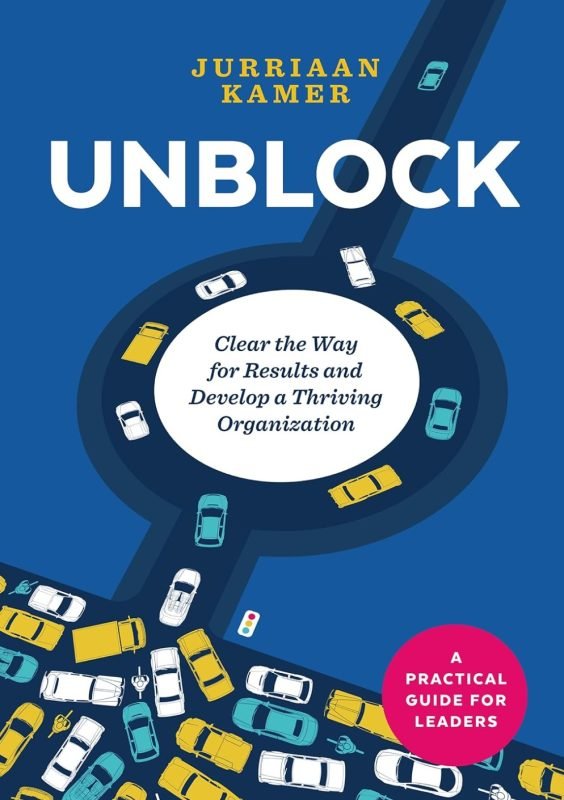
Visually, the book maintains a consistent identity through layout and typography. However, there is some unevenness in image quality and style. The combination of hand-drawn and icon-based visuals, along with a few externally sourced graphics, contributes to a slightly inconsistent look. Still, the cover design stands out, and its metaphor of clearing a traffic jam is vivid and well-aligned with the book’s core message.
Overall, Unblock offers meaningful educational value and a solid foundation for leaders looking to drive change, particularly those in agile or adaptive environments.
AIPMO scale
Unblock offers a highly readable experience, supported by strong grammar, clear structure, and accessible language. The logical sequencing of ideas and engaging real-world illustrations sustain reader interest throughout. For example, Chapter 5’s explanation of reversible decisions is presented with clarity and brought to life through a relatable story from a digital team—effectively delivering practical insights.
While the book includes a number of real and composite case studies, many of them remain relatively high-level and lack the depth needed to fully illustrate the complex dynamics at play. Rather than delving into the deeper organizational conditions, behavioral patterns, or systemic implications, the examples often stop at surface-level storytelling. Chapter 12, for instance, discusses ineffective meetings but offers limited insight into the broader structural or cultural causes behind them, relying instead on generalized observations.
Jurriaan Kamer is recognized both nationally and internationally for his work in organizational design and leadership. His earlier book, Formula X, was named by Forbes as one of the “five must-read books for today’s uncertain market.” A sought-after speaker, he has delivered keynotes at events such as Agile Amsterdam and has been featured in numerous podcasts and interviews on modern organizational practice
The book offers meaningful educational value through a structured format, practical examples, and clearly defined implementation steps. Its use of frameworks (e.g., 90-day outcome cycles, decision rights mapping) ensures that readers not only understand concepts but are also guided through their application. Chapter 1 through Chapter 12 build a progressive educational experience that reinforces learning and promotes retention. However, while the book provides sound advice, the depth of its action plans remains relatively high level, which may leave some practitioners seeking more detailed guidance.
The book draws from a strong foundation of current and directly relevant references across multiple domains, including organizational design, agile transformation, psychological safety, and systems thinking. Authors such as Amy Edmondson, Frederic Laloux, and Daniel Pink are cited, reinforcing the book’s credibility and thematic alignment. However, while these references are well-chosen, the book does not consistently situate its arguments within broader academic frameworks or established management theories. The emphasis remains highly practical — a strength for practitioners — but this focus may limit its appeal to readers seeking deeper theoretical grounding or empirical validation. For instance, the useful “Blockers” concept is not formally tied to systems theory or complexity science, which could have enhanced its academic robustness.
The book maintains a consistent visual identity through its use of layout, typographic style, and recurring design elements. The quality and style of the visuals vary: some appear hand-drawn while others use icon-based formats, leading to an uneven appearance. A few images are of lower resolution, and those sourced externally contribute to a slightly cluttered or inconsistent visual impression. This detracts somewhat from the otherwise well-structured narrative experience.