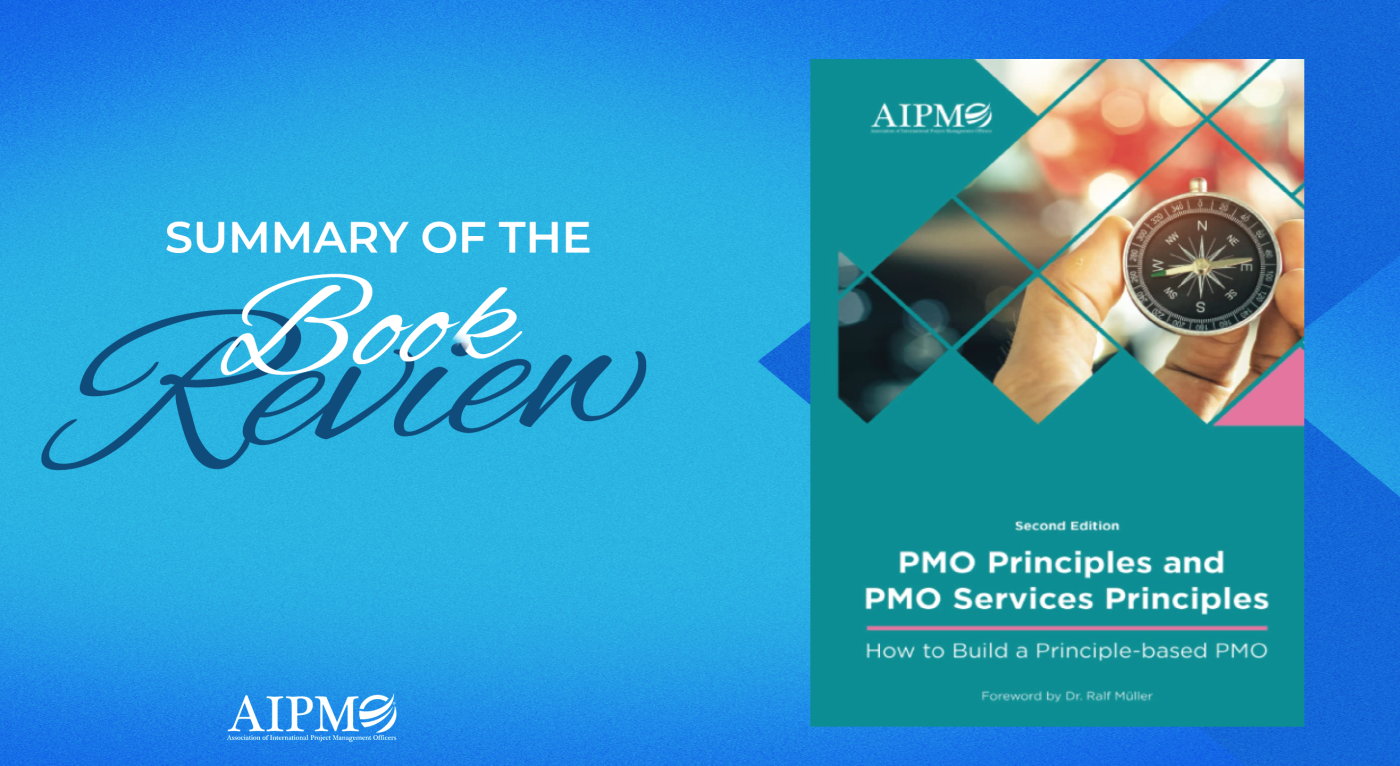
In “PMO Principles and PMO Services Principles – How to Build a Principle-based PMO,” Dr. Robert Joslin presents principles as a toolkit for designing, implementing, and operating a PMO customized to each organization’s unique needs and circumstances.
The book unfolds across three primary sections. It begins with an in-depth exploration of the fundamental PMO principles, enriched with descriptions, insights, and illustrative examples. The subsequent part focuses on the PMO service principles, specifically designed to align with the PMO services lifecycle framework. The book concludes with an overview of the PMO service domain principles, demonstrating their application within the service domain.
A principle is a natural law, fundamental truth, or proposition that serves as the foundation for a system of belief or behavior or a chain of reasoning.
I appreciate applying the Dreyfus model of skill acquisition to the realms of procedure- and principle-based services. The model suggests that the lower levels—novice, advanced beginner, and competent—benefit from procedural services, while the higher levels—competent, proficient, and expert—present an opportunity for principle-based services. This approach could also benefit maturity models, especially when transitioning from level 3 to 4, shifting from standard to adaptive processes.
The PMO principles
Principles are elucidated with definitions, tips, and examples provided. The seven PMO principles, along with their specific areas of focus, are detailed as follows:
- Sponsorship – Senior management sponsorship and engagement.
- Alignment – Governance alignment.
- Transparency – Consistent, accurate, timely, and transparent information.
- Challenge – Trusted challenge partner to drive value.
- Adjustment – Adaptive services and capabilities.
- Exemplar – Leads by example.
- Improvement – Continuous improvement mindset
When choosing a set of principles, performing an assurance check is crucial to verify that the selected principles deliver the anticipated impact. The book introduces a distinctive method for selecting the most appropriate principles for each PMO. For each principle, you assess whether its impact on the PMO objectives, the challenges faced by the PMO, and the systemic organizational issues are high, medium, or low. Principles that demonstrate the highest impact are then selected.
The significance of PMO principles and the extent to which they are integrated and maintained should be directly proportional to the PMO’s impact factor, acknowledging that other elements also contribute to the PMO’s overall impact.
PMO services principles
Part II elaborates on the PMO services principles, categorizing them according to each phase of the PMO services lifecycle. These phases include service strategy, service design, service pilot and implementation, service operation, and service transformation or retirement.
For each phase, you are presented with a collection of principles accompanied by their descriptions. The same selection method used for the PMO principles is applied to identify the most crucial principles.
PMO service domain principles
The final section outlines all 22 PMO service domain principles, organized into four clusters: conceptualization, planning, execution, and safeguarding the future. You will receive tips on how to master each service domain.
The appendix provides an overview of AIPMO’s PMO Strategic Lifecycle Framework, along with a list of acronyms, a glossary, and lists of the PMO, PMO service lifecycle, and PMO service domain principles
Conclusion
I highly recommend PMO Principles and PMO Services Principles for professionals seeking a structured, principle-based approach to PMO and PPM environments. The book effectively delivers actionable guidance, offering innovative solutions that enhance decision-making and professional practice. Its insights on building a PMO through principles, selecting the right ones, and leveraging shared principles provide a fresh perspective supported by relevant examples.
Please visit the book review page for a comprehensive evaluation of the book based on AIPMO’s 10-point scale.