






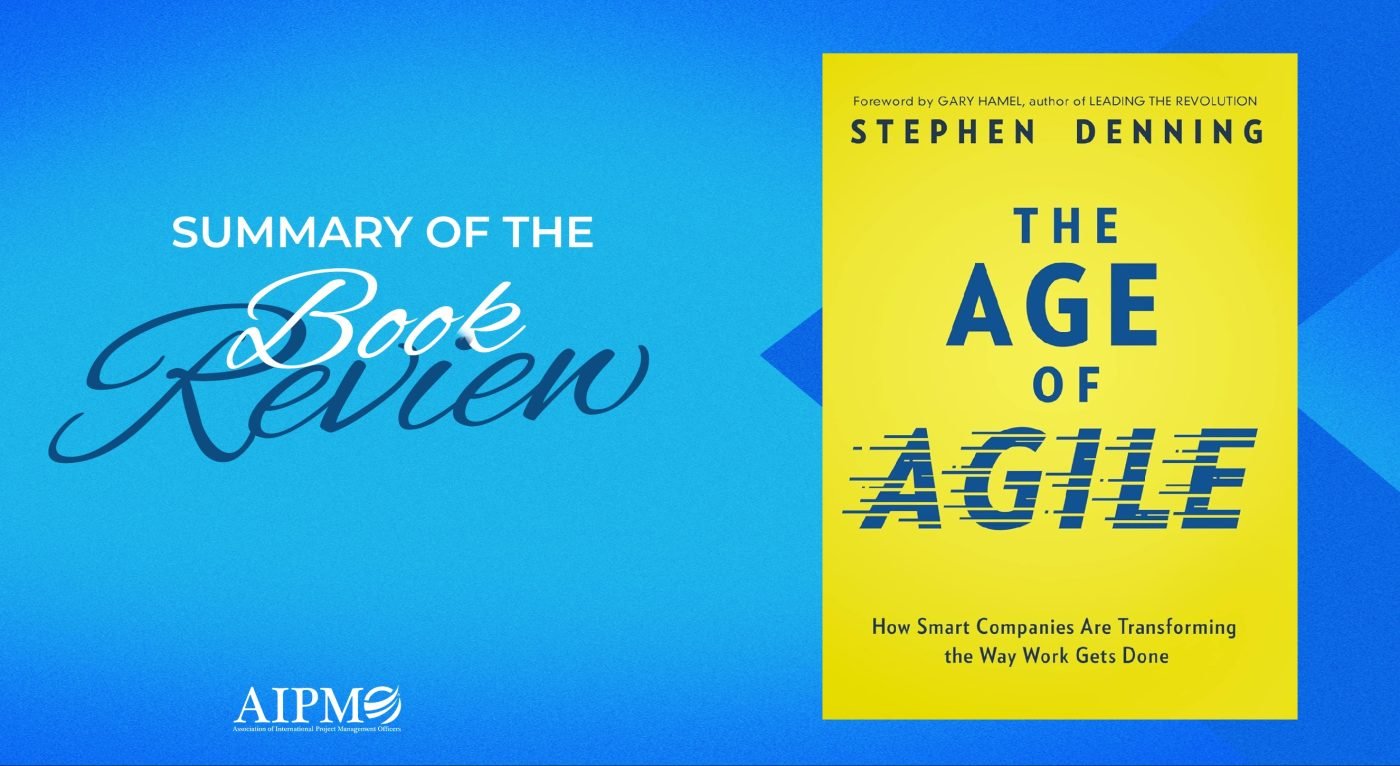
Stephen Denning wrote a very interesting and inspiring book, The Age of Agile – How Smart Companies Are Transforming The Way Work Gets Done. Not about agile frameworks, but what it really means to reach more agility.
The book is divided into two parts. The first part focuses on agile management, laws, a case study to implement agile at scale (Microsoft), and moving towards strategic agility and changing the organizational culture. The second part puts several management traps in the spotlight. E.g., shareholder value, share buybacks, cost-oriented economics, and backward-looking strategy.
Organizations that have embraced agile have three core characteristics:
- The law of the small team. “It’s a presumption that in a VUCA (volatility, uncertainty, complexity and ambiguity) world, big and difficult problems should – to the extent possible – be disaggregated into small batches and performed by small cross-functional autonomous teams working iteratively in short cycles in a state of flow, with fast feedback from customers and end-users.”
- The law of the customer. “Requires that the firm’s culture and internal systems, processes, and values themselves be continuously subordinated to, and driven by, delivering value to the customer: if there is a conflict, it is the customer’s needs that need to be given priority.”
- The law of the network. “An organizational network is a set of teams that interact with and collaborate with other teams with the same connectivity, interaction, and passion as they do within their own small team. Each team needs to look beyond its own goals and concerns and see its work as part of the larger mission of the collectivity.”

Common practices of agile small teams:
- Work in small batches
- Small cross-functional teams
- Limited work in process
- Autonomous teams
- Getting to “done”
- Work without interruption
- Daily stand-ups
- Radical transparency
- Customer feedback each cycle
- Retrospective reviews

Practices of the law of the customer:
- Target
- Constantly experiment
- Partner with start-ups
- Increase product malleability (turn a physical product into a digital product)
- Focus
- Innovate in short stages
- Evaluate
- Be willing to disappoint
- Deliver value faster
- Customize

Some hypotheses as to what it takes to make networks work:
- The network has a compelling goal
- The network comprises small groups
- The groups have an action orientation
- The network is the sum of the small groups
- The network’s legal framework stays in the background
The Microsoft case study implementing agile at scale gives helpful keys that are needed to make agile at scale:
- Get the right balance of alignment and autonomy (too much control, nothing gets done – too little control, it’s chaos)
- Master the role of the agile manager
- Handle dependencies at the team level
- Ensure continuous integration
- Keep on top of technical debt
- Embrace DevOps and continuous Delivery
- Continuously monitor progress
- Listen to the customer’s wants, but meet their needs
- Deal with directions from above
- Use self-forming teams to encourage team ownership
- Recognize the team is the product
- Build quality from the beginning
- Use coaching carefully
- Ensure top-level support.
The last two chapters of the first part explore what it means to move from operational to strategic agility. Generating innovations that create entirely new markets by turning non-customers into customers. Strategic agility is the next frontier of agile management. Start with market-creating value propositions based on four fundamental components: Need, Approach, Benefits per costs, and Competition (NABC).
In the second part, we are looking at organizations that are mainly focused on defending the status quo and protecting their existing business. They are not moving towards operational and strategic agility. They are blocked by traps of short-term shareholder value, share buybacks, cost-oriented economics, and backward-looking strategies.
- The trap of shareholder value. Maximizing shareholder value means top-down command-and-control management and, as a result, dispirited employees, less engagement, less innovation.
- The trap of share buybacks. Making profits (“corporate cocaine”) even as it systematically destroys its own earning capacity by handing over resources to shareholders, and as a result, there are insufficient resources to support investment and innovation.
- The cost-oriented economics trap. Cutting costs could lead to a permanent loss of expertise. Adding customer value at a lower cost is much more important.
- The trap of backward-looking strategy. These strategies are 100 percent accurate in hindsight, but in foresight, they miss the unexpected and the unforeseen.
The book concludes with an epilogue that discusses nuclear winters and golden ages, beginning in 1790 with the canals and ending in the era of computers and communications. We get an overview of different roles (from CEO’s to thought leaders and the media, and many more) and what they need to do to run organizations in a better way.
Conclusion: Great case studies to understand why we need the three laws of the customer, the small team, and the network. A must-read for those who want to make a shift to business agility.
In line with the agile manifesto and summarizing the second part of the book, I would say:
- Customer value over shareholder value
- Customer value over the organization’s efficiency
- Value-driven perspective over cost orientation
Please visit the book review page for a comprehensive evaluation of the book based on AIPMO’s 10-point scale.
