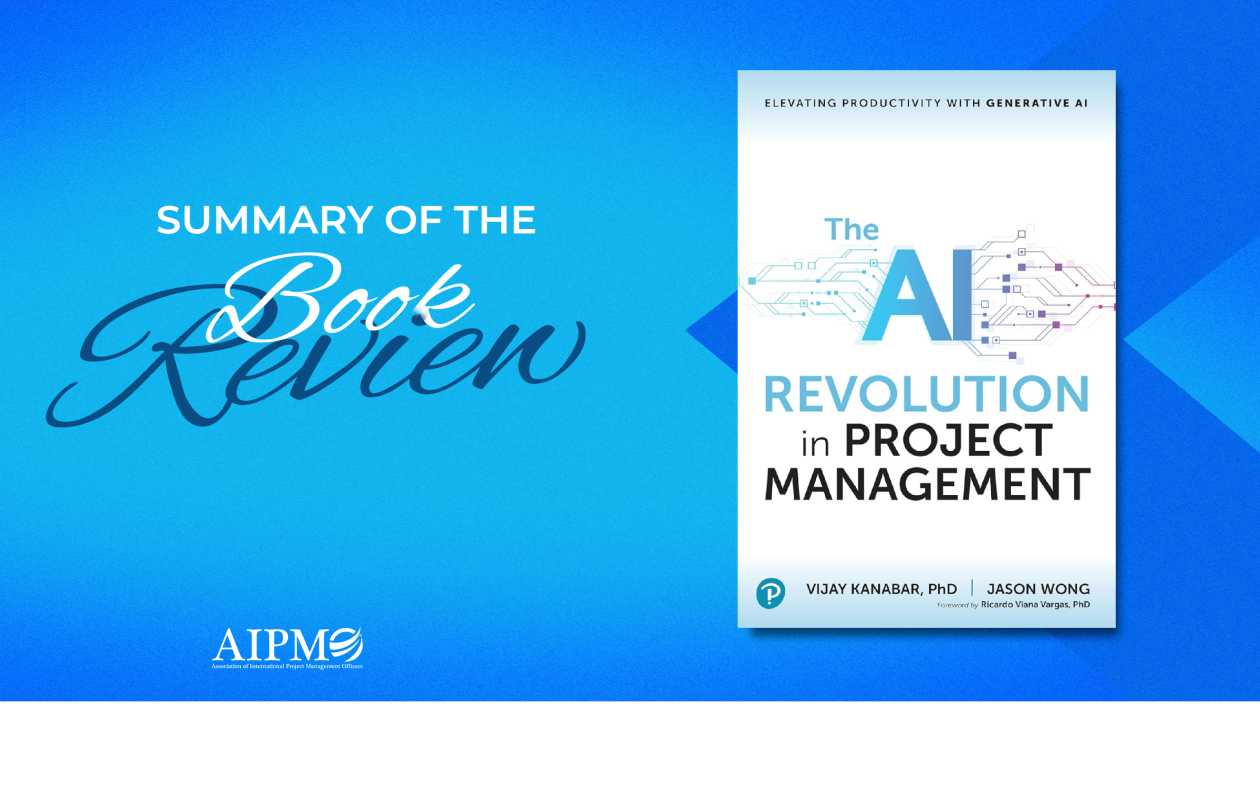
The AI Revolution in Project Management by Vijay Kanabar and Jason Wong provides prompts to assist you in the following project manager-related tasks: stakeholder management, building and managing teams, choosing a development approach, planning for predictive and adaptive projects, monitoring project work performance, risk management, and finalizing projects.
Every topic or chapter starts with a (fictional) case study, followed by an introduction and the usage of many well-crafted example prompts (ChatGPT) to support you, tips for how to improve these prompts to fit your needs, and elaborates on related ethical considerations and professional responsibility. At the end of each chapter, you get a technical guide with the practical implementation of AI (ChatGPT, Bard, Claude.ai). The last two chapters focus on AI tools for project management and looking ahead.
Ethical considerations and professional responsibility
The authors use a list of ethical considerations and professional responsibility in AI and highlight these when discussing the different PM-related topics: transparency, data privacy, bias mitigation, accountability, environmental considerations, regulatory oversight, human augmentation, hallucinations and data accuracy, and data ownership and training implications.
Stakeholder management
Projects succeed if you, as a project leader, successfully identify and engage stakeholders, constantly communicating with them and meeting their expectations. AI can help identify or update stakeholder lists by reviewing email threads or by explaining and comparing the project with similar projects. AI can perform a stakeholder analysis, understand their interests and needs, and generate a power versus interest matrix. AI can analyze stakeholder interactions to determine communication preferences and channels and help to draft personalized memos and progress reports, answer queries from stakeholders, perform stakeholder sentiment analysis, and predict stakeholder behavior.
Building and managing teams
AI reshapes recruiting onboarding, providing a swift, fair, and personalized experience. AI can perform automated screening, communicate with candidates, schedule interviews, and provide feedback, fair hiring due to the elimination of bias, and automated skill evaluations. AI can tailor onboarding and training initiatives to match your individual employees’ unique needs, skills, and learning styles. AI can augment leadership, facilitate communication, and provide early warning of issues. AI can set and communicate vision and direction and motivate teams. AI can help foster collaboration and support conflict resolution and decision-making.
Choosing a development approach
AI can help determine the approach to optimizing the project management life cycle (predictive, adaptive, and hybrid). It can help create a questionnaire to decide which approach to take. It can provide more helpful insights when specific project management documents and artifacts are uploaded (be aware of confidentiality). You could see AI as the consultant.
Planning for predictive projects
AI can, in an incremental and iterative way, support during project initiation and planning. It can assist with a needs assessment and business case creation and can draft a project charter. It can help in defining the scope, requirements, work breakdown structure and formulate schedules, cost estimation and budgeting.
Adaptive projects
AI can act as a consultant if you want to run an adaptive (agile) project. It can assist with the articulation of a vision statement and the creation and prioritization of a product backlog. It can identify customer personas. It can break the product backlog into iterations and a release plan, showing the main features. It can give examples of user stories, including acceptance criteria, a story map, and a walking skeleton. AI can build burnup or burndown charts and analyze them.
Monitoring project work performance
AI tools can process vast amounts of data, make predictions, generate reports, and converse using natural human language. It can join meetings to take notes, transcribe the conversation, and summarize key points, action items, and decisions. It can be used for task allocation, resource management, monitoring scope (creep) and schedules including EVA, controlling costs, and maintaining quality.
Risk management
AI can identify and analyze risks as well as plan responses and monitor progress. It can generate (and answer) questionnaires to gather expert opinions. It can construct a risk register. It can perform what-if scenarios in qualitative risk analysis, quantitative risk analysis, predictive modeling using data-driven forecasting, expected monetary value analysis, Monte Carlo analysis, and decision tree analysis. AI can plan and develop risk response strategies, monitor risk responses, and generate comprehensive risk reports and status summaries.
Finalizing projects
AI can help or act as a consultant during project verification, validation, creation of test plans, release (deployment), and closure (building the final project report and presentation, extracting key lessons learned).
AI tools
A separate chapter focuses on AI tools for project management. It offers factors that need to be considered when evaluating AI tools. The tools are clustered around several categories: project management systems (task allocation and tracking: Monday.com, Wrike, Asana, OnePlan, PMOtto), scheduling tools (Clockwise), communication and meeting tools (Slack GPT, Microsoft Teams Premium, Zoom AI companion), productivity and documentation tools (Microsoft 265 Copilot, Google Duet), collaboration and brainstorming tools (Miro).
Conclusion
In The AI Revolution in Project Management, the authors demonstrate how generative AI tools, particularly ChatGPT, can significantly aid a project manager. By using the appropriate prompts—the book provides numerous examples—one can greatly enhance one’s effectiveness and efficiency in daily tasks. This book is highly recommended for project managers.
For a comprehensive evaluation of the book based on AIPMO’s 10-point scale, please visit the book review page.